

Does the imam have a legal right to build the mosque at Ground Zero? The answer is yes. But is it the right thing to do? The answer is no. And most Americans, and most moderate Muslims, join with me in that call.
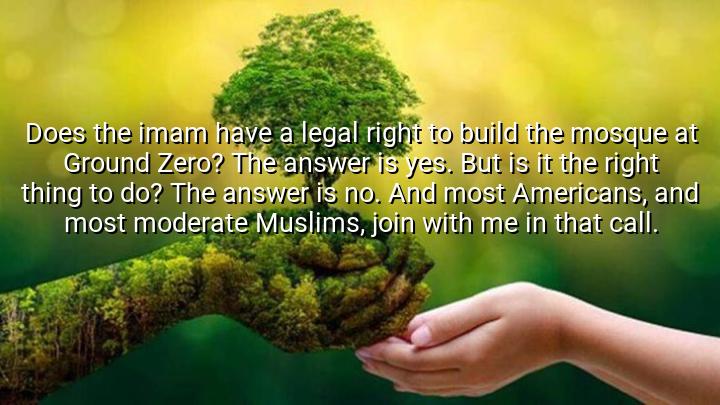




The quote by K. A. Paul addresses the controversy surrounding the construction of a mosque at Ground Zero, blending considerations of legal rights with moral and social judgment. Paul acknowledges that, under U.S. law, the imam has the legal right to build the mosque, reflecting the protections of religious freedom and the First Amendment. However, he argues that exercising this right in this particular context is not the right thing to do, emphasizing the ethical and emotional dimensions of the decision.
Paul highlights the tension between legal permissibility and social responsibility. While the law protects religious expression, the choice to construct a mosque at a site associated with the 9/11 attacks raises questions about public sentiment, sensitivity to victims, and broader cultural and moral considerations. His statement reflects the complex interplay between constitutional rights and societal values.
The origin of this perspective comes from Paul’s role as a political activist and evangelical leader, where he often commented on issues of religion, morality, and national identity. The Ground Zero mosque debate was a significant national conversation in the United States, raising questions about how far legal rights extend in cases with profound symbolic and emotional significance.
Ultimately, the quote underscores the distinction between what is legally allowed and what is ethically or socially appropriate. Paul argues that even when actions are lawful, they may still be controversial or inadvisable in light of public sentiment and collective moral judgment, highlighting the ongoing tension between law, ethics, and societal norms.

AAdministratorAdministrator
Welcome, honored guests. Please leave a comment, we will respond soon