

Confusion of goals and perfection of means seems, in my opinion, to characterize our age.
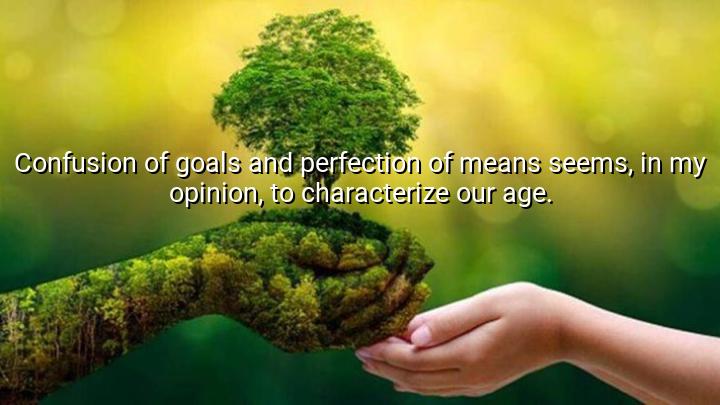




Albert Einstein’s quote, "Confusion of goals and perfection of means seems, in my opinion, to characterize our age," reflects his critique of modern society's focus on refining methods and tools without clear direction or understanding of the true purpose. Einstein argues that people often become so absorbed in perfecting the means—the techniques, technologies, or strategies they use—that they lose sight of their goals. This creates a situation where the means may be highly developed and efficient, but they do not necessarily lead to meaningful or beneficial outcomes.
The quote highlights the tension between means and ends, suggesting that society has become overly focused on technological and methodological advancements at the expense of understanding their true purpose. For Einstein, the confusion of goals in modern life—where people pursue perfection in their work, technology, or systems without clear moral or practical direction—leads to an unbalanced approach to progress. This criticism can be applied to many aspects of society, from scientific research to business practices, where the pursuit of efficiency or innovation often overshadows the deeper questions of why certain goals are being pursued.
Einstein, known for his revolutionary contributions to physics, frequently commented on the broader implications of science and technology on society. His deep concern for humanity’s ethical and philosophical direction can be seen in this quote, as he was acutely aware of the risks associated with technological advancements that were not guided by thoughtful or moral considerations. This was particularly pertinent in the context of the 20th century, when advances in nuclear energy and other technologies were rapidly changing the world.
In essence, Einstein’s quote serves as a cautionary reminder that progress and technology should be guided by clear, thoughtful goals, rather than an obsession with perfecting methods or tools. The true challenge of modern life, according to Einstein, is not merely to achieve perfection in how we do things, but to ensure that our goals are meaningful, ethical, and aligned with the well-being of society and the planet.

BDMai Dang Bao Duy
I think this quote captures the existential dilemma of our era. We’ve created machines that think, systems that run faster than we can process, and yet we seem to lack a shared sense of purpose. Are we mistaking capability for direction? This makes me wonder how education, policy, and leadership could shift to help us realign our goals with humanistic and long-term values. What would it take to reverse this confusion?
ACAgnes chill
As a reader, I find this quote deeply unsettling. It makes me question everything from social media algorithms to military advancements. We seem to be mastering the art of ‘how,’ but not the wisdom of ‘why.’ Is that why so many people today feel disillusioned or anxious despite all our progress? Maybe this is a call to redefine success—not by the perfection of our tools, but by the clarity of our vision.
AKPhung Anh Khoi
This is such a powerful and sobering idea. It feels like Einstein was warning us about the trap of technological arrogance—where we focus so much on how to do something that we forget why we're doing it in the first place. In our pursuit of scientific and economic efficiency, have we lost our moral compass? What role should ethics play in shaping the goals behind our increasingly perfect methods?
PLPhu Le
This quote hits hard, especially in the context of modern society. We’ve gotten so good at building tools, systems, and technologies, but what are they really for? Is our ultimate goal happiness, sustainability, or endless consumption? I think Einstein’s critique invites us to pause and reassess our priorities. Are we chasing goals that align with human values, or are we just mesmerized by the sophistication of our methods?
ADNguyen Anh Duc
Einstein’s observation feels even more relevant today than when he first said it. We’ve developed incredibly advanced technologies, perfected our tools, and optimized systems, but often we don’t know what we’re truly aiming for. Are we innovating for progress or just for profit? It makes me wonder: in a world obsessed with efficiency and productivity, have we forgotten to ask what kind of future we actually want to build?