

Citizens of Rome might boast that the claim of 'Civus romanus sum' set them apart from barbarians and slaves, and it was true up to a point, but Roman citizens lived in a society that accepted pain, cruelty, and torture as the norm, and in which there was no suggestion of equality at birth or mercy in the afterlife.
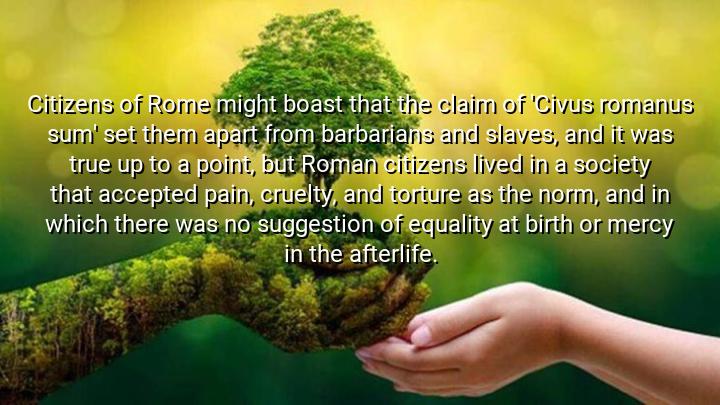




Michael Korda’s quote reflects on the idea of Roman citizenship and its complex relationship with power, society, and human rights. The phrase "Civus romanus sum" was a declaration of privilege, signifying a Roman citizen's status and protection under Roman law, which distinguished them from barbarians and slaves. However, Korda challenges the idealized view of Roman citizenship by pointing out the harsh realities of Roman society—where pain, cruelty, and torture were accepted as part of the norm, and where there was no concept of equality at birth or mercy in the afterlife. This critique suggests that despite the legal status and pride associated with being a Roman citizen, the society itself was far from just or compassionate.
The origin of this quote can be understood in the context of Korda’s broader commentary on history and society. As a writer and historian, Korda often explores the contradictions and complexities of historical narratives, particularly those surrounding power and societal values. In this quote, he uses Roman citizenship as a lens to discuss the broader themes of inequality and the limitations of privilege in ancient societies. His perspective invites readers to reconsider historical legacies that are often romanticized, showing that the status of being Roman was not synonymous with justice or humane treatment.
Korda’s critique also serves as a reminder that equality and mercy—concepts that are central to modern understandings of human dignity—were not inherent to Roman society. The Roman Empire was built on the exploitation of slaves and the subjugation of conquered peoples, and citizenship did not guarantee any form of moral superiority or social equity. Korda highlights that being a Roman citizen did not automatically ensure a just society, but rather was tied to the power structures that allowed cruelty and inequality to persist.
Ultimately, Michael Korda’s quote invites reflection on how societies justify inequality and suffering, even in the face of legal or institutional privileges. While Roman citizenship offered certain protections, it did not guarantee moral or social justice. By juxtaposing the boast of Roman citizens with the reality of their society, Korda emphasizes that legal status alone is not enough to create a fair and compassionate society, and that true equality requires much more than official recognition or legal rights.

AAdministratorAdministrator
Welcome, honored guests. Please leave a comment, we will respond soon