

Capitalism does not permit an even flow of economic resources. With this system, a small privileged few are rich beyond conscience, and almost all others are doomed to be poor at some level. That's the way the system works. And since we know that the system will not change the rules, we are going to have to change the system.
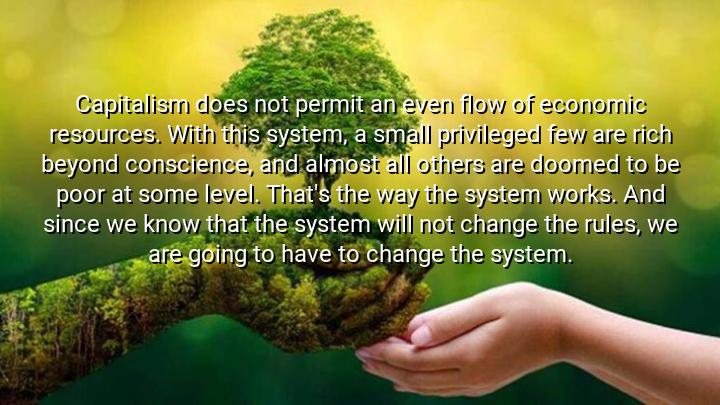




The quote "Capitalism does not permit an even flow of economic resources..." by Martin Luther King, Jr. offers a bold critique of economic inequality within the capitalist system. King argues that capitalism, in its prevailing form, inherently favors a small privileged few, allowing them to become "rich beyond conscience" while the vast majority remain economically disadvantaged. He points out that this imbalance is not accidental—it is built into the very structure of the system.
King’s message is rooted in a deep concern for social justice and economic fairness. By stating that the system will not change the rules, he acknowledges that mere reform is not enough. Instead, he calls for a fundamental change in the system itself, implying that true equity and dignity for all people can only come from rethinking and reconstructing how economic resources are distributed and how opportunities are made available.
Although widely known for his leadership in the civil rights movement, Martin Luther King, Jr. was also a powerful advocate for economic justice. In the later years of his life, especially during the Poor People’s Campaign, he began to speak more openly about structural inequality, linking poverty, racism, and economic exploitation as interconnected forces of oppression. This quote reflects his growing commitment to challenging not just legal segregation, but the economic systems that perpetuate human suffering.
Ultimately, King's words remain a powerful call for systemic transformation. They remind us that true justice requires more than symbolic change—it demands a willingness to confront entrenched power structures and build a more inclusive and compassionate society. His critique of capitalism wasn't a rejection of progress or productivity, but a plea for economic morality, where human dignity is valued above unchecked profit.

AAdministratorAdministrator
Welcome, honored guests. Please leave a comment, we will respond soon