

But I don't think that it's a form of family that I would be comfortable in. I've found a way to this character and this family, but I still believe that a marriage is between two people and not seven or three.
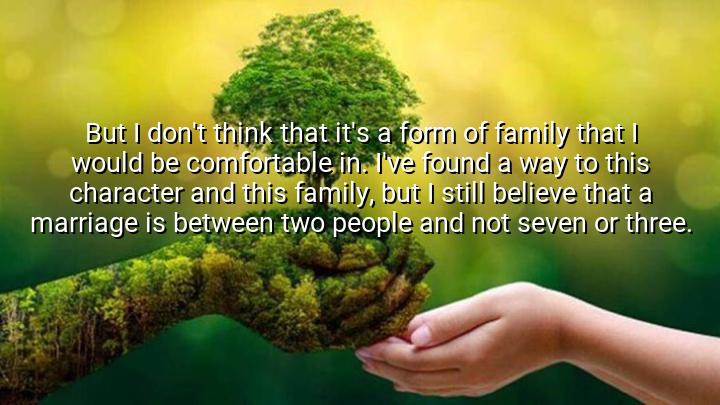




The quote by Jeanne Tripplehorn reflects her personal views on marriage and family structures, particularly in relation to her work as an actress. She acknowledges that she was able to portray a character in a story involving unconventional family dynamics, but she distinguishes that from her own beliefs. Tripplehorn emphasizes that, in her view, marriage should be between two people, not expanded into arrangements involving “seven or three.” This highlights the difference between her professional role and her personal values.
The origin of this statement comes from Tripplehorn’s work on the television series Big Love (2006–2011), in which she played Barb Henrickson, the first wife in a polygamous marriage. The show explored the complexities of plural marriage in modern America, particularly within certain religious communities. While she was able to step into and understand her character’s world for the sake of her performance, Tripplehorn clarified in interviews that she personally did not support or feel comfortable in such family structures.
Her comments also touch on the broader cultural debates surrounding marriage and alternative family forms. While some societies and religious groups practice polygamy, mainstream Western culture, including in the U.S., has largely upheld the ideal of marriage as a union between two individuals. Tripplehorn’s stance reflects this perspective, affirming her belief in monogamy while still showing respect for the fictional world she was portraying.
In summary, Tripplehorn’s quote distinguishes between artistic exploration and personal conviction. While she was able to immerse herself in a role that involved an unconventional marriage, she reaffirmed her own belief that marriage is best understood as a commitment between two people. Her words highlight both the challenges of acting in roles that differ from one’s own values and the enduring cultural conversation about the meaning of marriage.

AAdministratorAdministrator
Welcome, honored guests. Please leave a comment, we will respond soon