

Birth was the death of him.
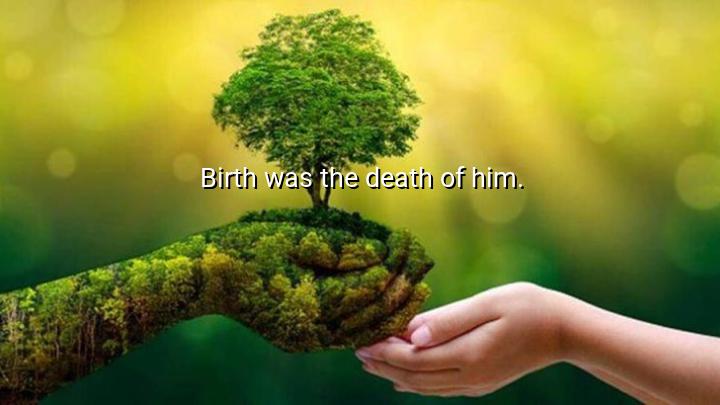




The quote "Birth was the death of him" by Samuel Beckett reflects the existential themes present in much of his work, particularly the absurdity of life and the inevitable decline of the human condition. Beckett, known for his darkly philosophical plays like Waiting for Godot, often explored the tension between existence and meaninglessness. In this quote, the statement that birth was the death of someone suggests that from the moment of birth, one is inevitably moving toward their eventual end. Life itself, in Beckett’s view, can be seen as a gradual progression toward death, where the start of life is intrinsically linked to the end.
The phrase also speaks to the futility and circularity of life that Beckett often depicted in his works. The idea that birth is the beginning of death captures the notion that life is filled with suffering and that each moment lived is one step closer to its inevitable conclusion. This view is influenced by Beckett’s broader existential philosophy, which emphasizes the absurdity of trying to find meaning in life when it is ultimately fleeting and subject to inevitable decay.
The origin of this quote comes from Beckett’s exploration of the human condition in his writings. In much of his work, particularly in plays like Endgame and Krapp’s Last Tape, Beckett focuses on themes of mortality, memory, and the passage of time. This quote can be seen as an encapsulation of the bleak, yet deeply reflective perspective on life that runs throughout Beckett's oeuvre, where the act of living and dying are inseparable.
Ultimately, this quote challenges conventional views of birth and life as positive or hopeful events. Instead, it suggests that life itself, by virtue of beginning, is already tied to the inevitability of death, which Beckett frames as a key part of the absurdity of human existence. By stating that birth is the death of someone, Beckett forces us to confront the uncomfortable reality that from the moment we are born, we are on an irreversible path toward our end.

AAdministratorAdministrator
Welcome, honored guests. Please leave a comment, we will respond soon