

As you age naturally, your family shows more and more on your face. If you deny that, you deny your heritage.
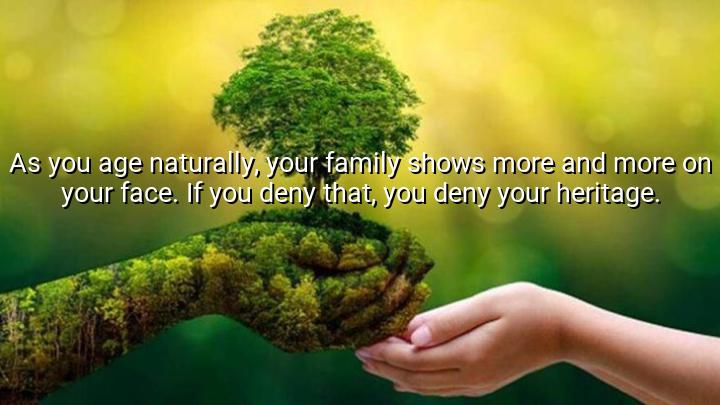




The quote "As you age naturally, your family shows more and more on your face. If you deny that, you deny your heritage" by Frances Conroy speaks to the deep connection between age and family heritage. Conroy, an American actress, reflects on the physical signs of aging as a way to honor one’s ancestry. The idea that family shows on your face with age suggests that the traits and features passed down through generations become more visible as time goes on. As you age, your physical appearance often starts to resemble that of your parents or ancestors, carrying their legacy in a way that is both literal and symbolic.
Conroy’s words emphasize the importance of accepting these changes as part of one’s personal and family history. Instead of fighting or feeling embarrassed by the physical signs of aging, such as wrinkles or expression lines, she suggests that embracing them is a way of acknowledging and celebrating your heritage. These marks of age can be seen as a reflection of the life lived, carrying the memories and experiences of the generations before.
The quote also suggests that rejecting the changes that come with aging is akin to rejecting one’s roots. Denying the aging process, according to Conroy, is like denying the very family and history that shaped who you are. Instead of hiding or trying to reverse the physical evidence of age, Conroy advocates for embracing these signs as a form of respect for the legacy passed down through your family, acknowledging the continuity of life through generations.
Ultimately, Conroy’s quote encourages a perspective on aging that is both accepting and proud. It serves as a reminder that as we age, we become more connected to our family heritage and ancestral roots, and that our physical features reflect this natural bond. Aging, then, is not something to hide from but a chance to honor and celebrate the legacy that has shaped us.

KNNguyen Khoi Nguyen
This quote feels like a challenge to a culture that encourages us to erase the past with creams, filters, and surgeries. Is aging naturally an act of resistance now? If embracing your evolving face means embracing your family and your story, then covering it up might be more than just vanity—it could be a kind of denial. I’d love to hear more perspectives on this. Is this idea empowering or limiting?
ANHai Anh Nguyen
It’s fascinating how this quote suggests that our faces become a kind of living family album. I hadn't really thought of aging that way before. It raises a complex question: what happens when someone feels estranged from their family or disconnected from their roots? Is accepting one’s aging still an act of honoring a heritage, even if that heritage is conflicted or painful? There’s a lot to unpack emotionally there.
TD8C-O6- Nguyen Thanh Dat
I love the quiet strength behind this quote. It makes aging feel less like a loss and more like a revelation. But I wonder—do men and women experience this sentiment differently, given how differently society pressures them about their looks? Is the idea of aging as a form of visible heritage more empowering for one gender than the other, or can it be universally embraced as a sign of connection and pride?
PNPth NgOc
The quote hits on something deeply human: the idea that time reveals more than it hides. I’m curious, though—how do we balance this natural aging with the cultural obsession with youth and cosmetic enhancements? If people alter their appearance to ‘stay young,’ are they also trying to escape their roots, consciously or not? And what does that say about how we view family, legacy, and self-worth in today’s world?
HPNguyen Ngoc Hoang Phuong
I find this quote both poetic and grounding. There’s something beautiful in the idea that our faces become a mosaic of our lineage over time. But I wonder—how does this idea sit with people who’ve had painful or complicated relationships with their families? Can the face still be a celebration of heritage in those cases, or does it become a reminder of wounds some may wish to forget?