

As nightfall does not come at once, neither does oppression. In both instances, there is a twilight when everything remains seemingly unchanged, and it is in such a twilight that we all must be most aware of change in the air - however slight - lest we become unwitting victims of darkness.
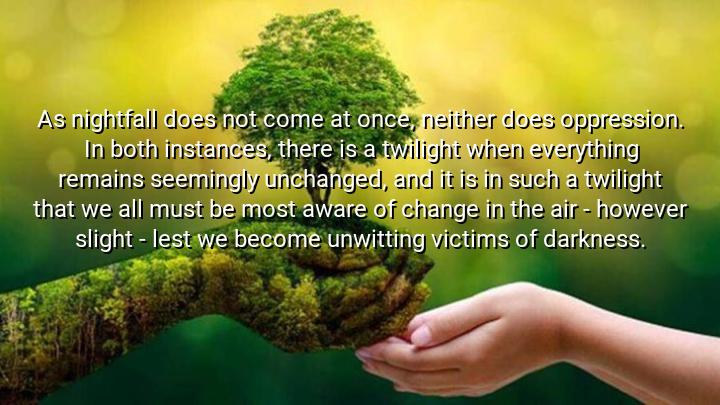




The quote “As nightfall does not come at once, neither does oppression. In both instances, there is a twilight when everything remains seemingly unchanged, and it is in such a twilight that we all must be most aware of change in the air—however slight—lest we become unwitting victims of darkness” by William O. Douglas is a profound warning about the gradual nature of oppression. Douglas draws a powerful analogy between the slow onset of nightfall and the subtle emergence of injustice. Just as darkness doesn't descend all at once, tyranny and erosion of rights often unfold gradually, under the guise of normalcy.
William O. Douglas served as a U.S. Supreme Court Justice from 1939 to 1975 and was known for his strong advocacy for civil liberties, individual rights, and environmental protection. His experience on the bench during times of significant social and political change gave him a deep understanding of how freedoms can be threatened—not always by sweeping actions, but by small, often unnoticed shifts in policy or public sentiment. The quote reflects his belief in the need for vigilance and awareness, especially during times of subtle transition.
The “twilight” Douglas refers to is the period when change is occurring, but its consequences are not yet fully apparent. It is a deceptive phase where society may feel secure, but beneath the surface, liberties are being compromised. He urges individuals to pay close attention during these moments of uncertainty and ambiguity, because failing to recognize these early signs may lead to becoming unwitting victims of larger, more dangerous developments.
Ultimately, this quote is a call for conscious engagement and responsibility. It reminds us that preserving freedom and justice requires not just reacting to overt acts of oppression, but also recognizing and questioning the more subtle, creeping changes that can lead to darkness. Douglas emphasizes that awareness is the first line of defense in protecting democratic values.

AAdministratorAdministrator
Welcome, honored guests. Please leave a comment, we will respond soon