

We are a religious people whose institutions presuppose a Supreme Being.
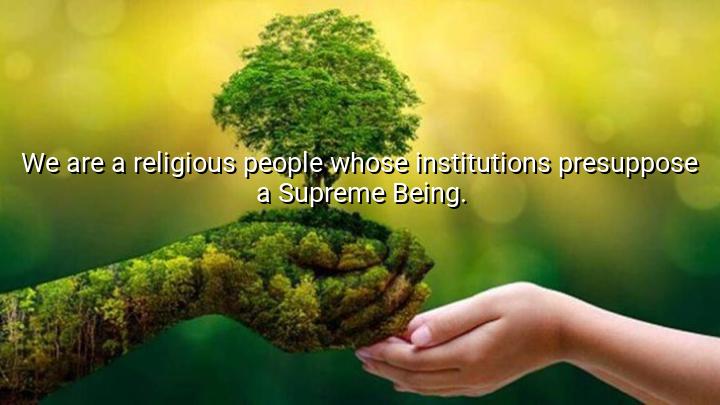




In this quote, William O. Douglas, a U.S. Supreme Court justice, reflects on the deep connection between religion and American society. He asserts that American institutions are inherently shaped by the assumption of a Supreme Being, referring to God. By saying "we are a religious people," Douglas emphasizes that religion has been integral to the foundation and development of American culture and governmental structures. He argues that the very functioning of these institutions presupposes a belief in something higher, suggesting that religious faith has a profound influence on the moral and ethical underpinnings of American law and society.
Douglas’s statement can also be seen as a defense of the role of religion in public life, particularly in relation to the First Amendment of the U.S. Constitution. While the First Amendment guarantees the separation of church and state, Douglas implies that this separation does not mean religion is absent from public life or the nation’s founding principles. Instead, he suggests that religious beliefs and the idea of a Supreme Being are so embedded in the nation's institutions that they are often assumed or taken for granted, even in secular contexts.
At the same time, this quote highlights Douglas's personal belief in the importance of religion in public and political life, a theme that ran through his career. As a staunch liberal and civil liberties advocate, he often supported individual freedoms, including freedom of religion, but this quote also reveals his recognition of religion's enduring influence in shaping the nation's values and laws. Douglas saw the moral framework provided by religion as integral to maintaining the nation's sense of justice and rightdoing.
The origin of the quote comes from William O. Douglas, who served as a justice on the U.S. Supreme Court from 1939 to 1975. Known for his liberal views on civil rights, free speech, and constitutional interpretation, Douglas often incorporated his belief in the intersection of religion and public life into his legal philosophy. This quote reflects his view that religion was not merely a private matter but something that shaped the ethical and legal fabric of the United States.

AAdministratorAdministrator
Welcome, honored guests. Please leave a comment, we will respond soon