

As human beings, our greatness lies not so much in being able to remake the world - that is the myth of the atomic age - as in being able to remake ourselves.
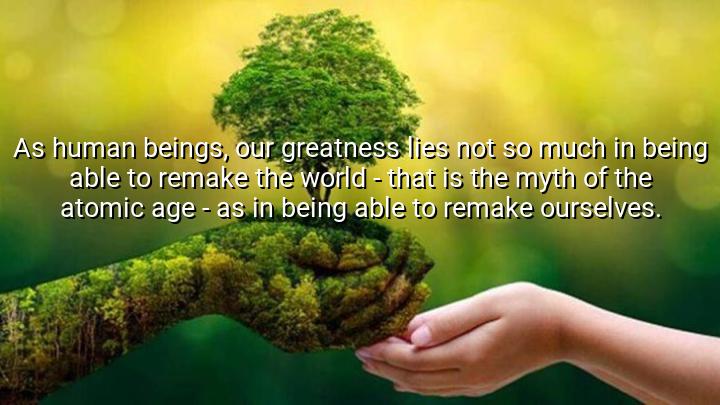




Mahatma Gandhi’s quote, "As human beings, our greatness lies not so much in being able to remake the world - that is the myth of the atomic age - as in being able to remake ourselves," emphasizes the idea that true greatness does not come from external power or the ability to change the world through technology or force. Instead, Gandhi argues that the most profound form of change lies within—our ability to transform ourselves. This perspective challenges the belief prevalent in the atomic age, where technological advancements and scientific discoveries often lead people to believe that humanity’s progress is defined by reshaping the world around us.
The quote also critiques the myth of the atomic age, a period characterized by rapid scientific developments, particularly the invention of nuclear weapons, which gave people the illusion that their ability to change the world through technology was a sign of true progress. Gandhi, however, suggests that the real challenge and potential for greatness lies not in controlling the external world but in mastering our inner selves—our values, actions, and personal growth.
Mahatma Gandhi, an iconic leader of the Indian independence movement, was known for his philosophy of nonviolence and personal transformation. His approach was grounded in the belief that social and political change should begin with individual moral and spiritual development. Gandhi’s emphasis on the importance of self-remaking reflects his core belief that the fight for justice and freedom must start with the individual’s commitment to ethical living and inner peace.
In essence, Gandhi’s quote underscores the idea that true greatness comes from within. While external circumstances may change through technology or power, it is our ability to change and improve ourselves—through personal growth, compassion, and self-awareness—that defines our real potential as human beings. This focus on inner transformation offers a more lasting and meaningful form of progress than any technological or worldly conquest.

CNLam Canh Nhi
I find this quote both inspiring and daunting. The idea that the real challenge is to evolve as individuals rather than control our environment forces me to examine my own resistance to change. It’s easier to critique society than to critique myself. What are the tools we need to actually remake ourselves—therapy, philosophy, meditation, community? And how do we sustain that effort when the world around us is still so chaotic?
TThái
There’s something beautiful and almost spiritual in Gandhi’s emphasis on the inner life. In a culture that often rewards external success, this quote is a reminder that true greatness might not be visible at all. It makes me wonder: what does it mean to 'remake' oneself? Is it about letting go of ego, forgiving past mistakes, or living more ethically? That journey feels deeply personal but universally needed.
BN21_Tran Dieu Bao Ngoc_7A3
This quote brings up an interesting tension: should we prioritize self-development or societal change? Gandhi seems to suggest they’re linked, that better people build better societies. But how does that play out in practice? Can we really remake ourselves in isolation, or is change more powerful—and more difficult—when done in relationship with others and through community accountability?
KHPham Thi Kim Hue
Gandhi’s statement challenges the very foundations of modern progress. It questions whether our technological leaps actually reflect any true human advancement. In an age of AI and space travel, it’s sobering to think that emotional maturity, compassion, and self-awareness might be more important. Why do we invest so little in personal growth, mental health, or ethical education compared to tech innovation?
HHungTheSpike
I really resonate with this idea. It’s easier to blame or try to change the world than to take the difficult steps of transforming ourselves. The atomic age promised so much external power, but are we any happier or wiser? Gandhi reminds us that real power lies in mastering the self. What small daily habits or reflections can we start with to begin that internal transformation he’s pointing to?