

Anyone who stops learning is old, whether at twenty or eighty. Anyone who keeps learning stays young. The greatest thing in life is to keep your mind young.
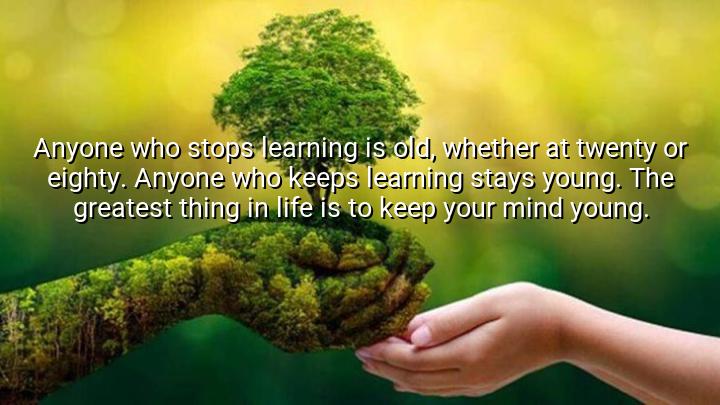




The quote "Anyone who stops learning is old, whether at twenty or eighty. Anyone who keeps learning stays young. The greatest thing in life is to keep your mind young," by Henry Ford, emphasizes the importance of continuous learning as a key to staying mentally youthful and vibrant. Ford suggests that age is not determined by the number of years lived, but rather by one's commitment to growth and curiosity. Whether someone is 20 or 80, the moment they stop seeking knowledge or new experiences, they begin to stagnate, becoming "old" in spirit, regardless of their physical age.
Henry Ford, an American industrialist and founder of the Ford Motor Company, was known for his innovative thinking and emphasis on progress and education. His quote reflects his belief in the power of a growth mindset, where learning is seen as the key to maintaining vitality and enthusiasm. For Ford, the act of learning is what keeps the mind sharp and engaged, which in turn keeps the person feeling young at heart.
The central idea of the quote is that mental agility and curiosity are the true markers of youth. Learning isn't just about acquiring new information, but about maintaining an open and flexible attitude towards life. Ford highlights that it's not the physical body that determines age, but the mental attitude. People who continuously engage with the world, remain open to new ideas, and challenge themselves are the ones who stay young in spirit.
Ultimately, Ford's quote serves as a reminder that age is not just about time but about perspective. The greatest thing in life, according to Ford, is to keep your mind young by staying curious, never ceasing to learn, and remaining open to new experiences. This mindset leads to a life of growth, vitality, and joy, regardless of how many years one has lived.

PTPhuong Thao
I love the idea that age is more of a mindset than a number. This quote gives agency back to the individual—it’s not about how many years you’ve lived, but whether you’re still curious. Still, I wonder what learning looks like as we age. Are there different ways older adults can engage their minds that are more rewarding than just reading or lectures? Maybe mentoring, storytelling, or travel play a role too?
Ccloudy
Ford’s message makes me feel hopeful, but also a little anxious. If learning is what keeps us 'young,' does that mean moments of stagnation are dangerous? Life isn’t always inspiring—sometimes it’s just survival. How do you maintain a sense of curiosity when you’re overwhelmed or burned out? I think this quote could be a double-edged sword unless we’re honest about the emotional work involved in staying mentally engaged.
BC03Trinh thi Bao chi
This quote rings true for me because I’ve seen it play out in real life. My grandmother took up painting at 82 and is more vibrant than ever. But it does raise a question: is the ability to keep learning a privilege? Not everyone has the time, energy, or resources. How can we make lifelong learning more accessible, especially for those juggling work, caregiving, or health challenges?
Mmimichan
There’s something really powerful about linking youth to curiosity instead of age. It makes me wonder how society would change if we celebrated intellectual engagement more than physical appearance. Could we redefine what it means to 'grow old' by valuing mental agility over external youth? I’d love to hear thoughts on how different cultures treat lifelong learning—are there societies that already live by this idea more than others?
THNguyen T. Thuy Hien
I find this quote by Henry Ford incredibly motivating, especially in an age where continuous learning is more accessible than ever. But I’m curious—does ‘learning’ have to be formal, like classes and books, or can it include learning from relationships, experiences, and failure? I think the broadest definition of learning makes this quote more relatable and inclusive. What kinds of learning do people find most rejuvenating and meaningful in their daily lives?