

An age is called Dark not because the light fails to shine, but because people refuse to see it.
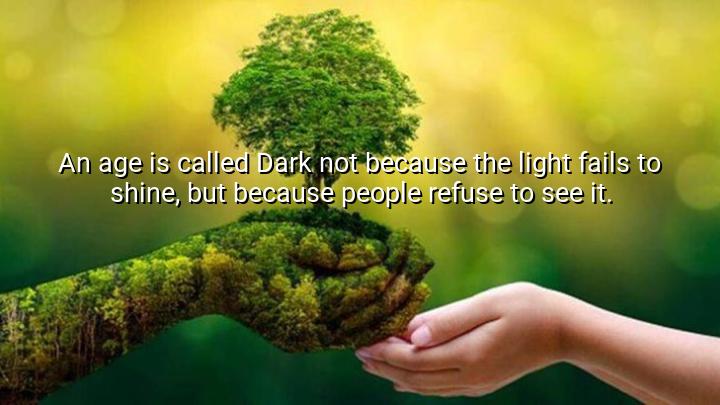




James A. Michener’s quote, "An age is called Dark not because the light fails to shine, but because people refuse to see it," reflects on the idea that periods of darkness or hardship in history are not necessarily caused by the absence of opportunity or progress, but rather by the collective failure of people to recognize or embrace it. Michener suggests that even in times of difficulty or turmoil, there is always the potential for growth and enlightenment, but it is up to individuals to be aware and open to those possibilities. When people fail to acknowledge or seek the light around them, they create their own darkness, choosing ignorance over insight.
This quote emphasizes the human tendency to overlook solutions or to remain trapped in negative thinking, despite the resources or opportunities available. Michener is calling attention to the importance of awareness and perspective. The light represents hope, knowledge, or progress that may be present, but if people are unwilling to engage with it, the dark age persists. In this way, the problem lies not with the world itself but with the mindset of those living in it.
James A. Michener, an American author known for his historical fiction, often explored themes of history, culture, and human nature. His perspective in this quote is rooted in the idea that society’s progress is not only determined by external factors but also by its collective will to acknowledge and act on the possibilities around them. His writing often examined how individuals and societies respond to change and adversity, making this quote a reflection of his broader views on human potential.
In essence, Michener’s quote encourages individuals to recognize the light in difficult times and not let their own refusal to see it create a self-imposed dark age. It serves as a reminder that progress and enlightenment are always within reach, but they require an openness to change and the courage to embrace new perspectives.

TYVu Thi Yen
What I love about this quote is that it flips the usual idea of a 'dark age' on its head. It places the burden of responsibility not on fate or circumstance, but on individual and collective perception. It makes me question my own blind spots — what truths am I ignoring out of convenience or fatigue? And more broadly, what 'light' might society be missing simply because it's inconvenient to accept?
GDGold D.dragon
Michener’s quote feels like a warning. It implies that every generation has the tools for enlightenment but can still spiral into darkness by choice. That’s a sobering thought. It makes me think about education, critical thinking, and open-mindedness — do we invest enough in these to make sure light is not just present but actually seen? Or are we conditioning ourselves to be blind to complexity and nuance?
DNPham Duy Nam
This line made me think about how responsibility for awareness falls on all of us. It's not enough to say things are bad — the quote challenges us to question whether we're actively ignoring truth, progress, or opportunities for change. I wonder how many injustices persist not because we can’t see them, but because we look away. How do we cultivate the moral courage to see what’s uncomfortable?
TNTai Nguyen
Reading this quote makes me wonder how much of history’s darkness came from deliberate blindness. It's a bit haunting, really — the idea that light was always present, but people chose not to see. What causes that kind of willful ignorance? Fear? Power? Convenience? It challenges the assumption that darkness is passive. Maybe every age has light, but not every generation has the courage to face it.
TTTuyet Tiet
This quote is incredibly powerful. It suggests that ignorance isn't always due to a lack of information, but often a refusal to acknowledge what's already in front of us. That really resonates with me, especially in today's world where truth can feel distorted by personal bias or media filters. Are we living in our own version of a 'Dark Age' simply because too many people choose comfort over clarity?