

Aging is not lost youth but a new stage of opportunity and strength.
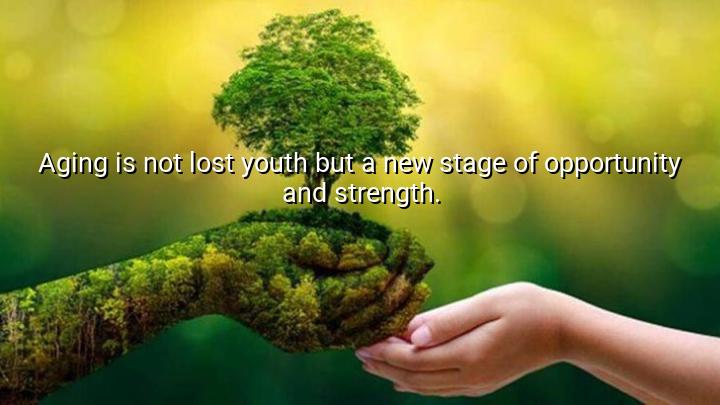




The quote "**Aging is not lost youth but a new stage of opportunity and strength," by Betty Friedan, challenges the conventional notion that aging is a process of decline or loss. Friedan suggests that rather than seeing aging as the end of youth, it should be viewed as a new phase in life filled with fresh possibilities and strengths. With age comes wisdom, experience, and a different kind of vitality that allows for growth and transformation, offering new opportunities for personal development.
Betty Friedan, a prominent American feminist and social activist, was known for her advocacy for women's rights and her exploration of the female experience. Her words here reflect a shift in perspective, encouraging individuals to embrace aging as a time of potential rather than a time of loss. This aligns with her broader work, which often focused on empowering individuals, particularly women, to redefine societal expectations and limitations placed upon them.
Friedan’s quote emphasizes the idea that aging should not be seen negatively, but as a time to harness new sources of strength. As people age, they accumulate knowledge and resilience that can lead to greater self-assurance and clarity. Aging is a period to shift focus from the physicality of youth to the inner resources that become more pronounced with experience, such as emotional maturity and confidence.
Ultimately, this quote calls for a positive and empowering outlook on aging. Instead of mourning the loss of youth, it encourages embracing the richness that comes with growing older. Friedan reminds us that aging is an opportunity to embrace new challenges, contribute wisdom, and tap into a deeper sense of strength that may not have been accessible in earlier years.

TTTan Trinh
I love the idea of aging being a stage of strength, not loss. It flips the script on what society often tells us. But how do we prepare younger generations to view aging this way so they grow into it with optimism rather than dread? Should this kind of mindset be taught early on? I think conversations like this are crucial if we want to change how people experience and perceive growing older.
TLThi thuy Le
Friedan's words are incredibly inspiring, but I can't help but think about how aging is portrayed in media and popular culture—usually as something to dread or delay. How can we shift that narrative to something more like what she describes? Are there enough role models or public figures showing aging as a stage of empowerment? Maybe we need more visibility around older people doing amazing things.
HVHoangthai Vo
There’s a strength in this quote that I admire. It feels almost like a rallying cry to embrace each stage of life fully. But I wonder, how do we cultivate that sense of strength and purpose as we get older? Is it a mindset that’s learned, or does it come naturally with experience? And do our cultural attitudes toward aging help or hinder people from seeing it this way? Thought-provoking stuff.
TTThao Thao
What I like about this quote is how it reframes the conversation around aging. It speaks to resilience, purpose, and personal growth. But I’d love to ask—what kinds of opportunities do people usually find in later life? Is it more about career changes, mentorship, community roles, or something else entirely? It makes me think of retirement not as an ending but as a beginning. Would love to hear real-life stories that reflect this idea.
UPUyen Phuong
This perspective is refreshing. It suggests that aging isn’t about decline but evolution. But I wonder, how much of this positive view of aging depends on socioeconomic factors? Is it easier to see aging as empowering if you’re financially secure or in good health? What happens to this narrative for people struggling later in life? I think the quote is uplifting, but I’m curious how widely it applies across different life situations.