

'Age' is the acceptance of a term of years. But maturity is the glory of years.
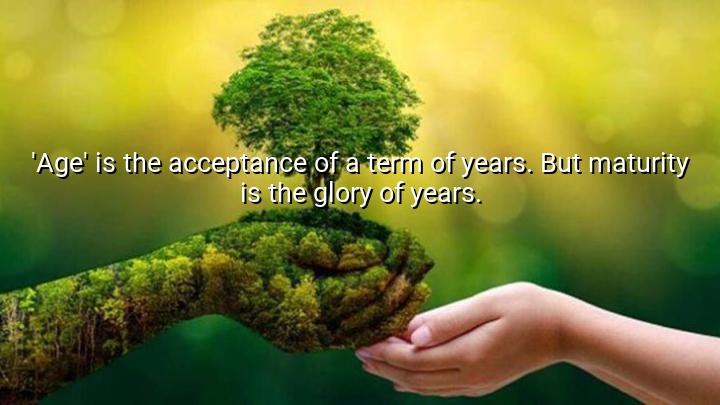




The quote "'Age' is the acceptance of a term of years. But maturity is the glory of years" by Martha Graham distinguishes between age and maturity, emphasizing that while age is simply the passage of time, maturity is a reflection of the wisdom and growth accumulated over those years. Graham, a renowned American dancer and choreographer, often explored themes of personal expression and self-awareness in her work. Here, she suggests that while growing older is inevitable, it is the process of maturing—both emotionally and intellectually—that brings true value to our years.
The first part of the quote, "Age is the acceptance of a term of years", highlights the inevitability of aging. Age, in this sense, is simply a number, a measurement of time passing, and something we cannot avoid. It is a natural and factual process that marks the physical and chronological progression of life, but it doesn't inherently carry any depth or meaning beyond the passage of time.
In contrast, "maturity is the glory of years" emphasizes the inner growth that can come with age. Maturity is not just about getting older but about gaining insight, wisdom, and a deeper understanding of life. Maturity involves emotional and mental development that allows us to embrace the challenges and rewards of aging with grace and strength. It is in maturity that we find the true beauty of the years we live, as it reflects a life well-lived, marked by experience and self-awareness.
Ultimately, Graham’s quote encourages us to view aging not as a decline but as a natural progression toward maturity, which brings its own glory. It invites us to appreciate the wisdom that comes with age, and to recognize that maturity is what truly defines the value of the years we accumulate, rather than the number of years themselves.

TVThanh Van
This quote made me pause. It seems to challenge the idea that aging is something to dread by offering maturity as its meaningful counterpart. But I’m curious—can we truly embrace this mindset in a culture that often celebrates superficial youth over inner growth? If maturity is the glory, why don’t we showcase it more often in media, leadership, or even fashion? It feels like we still have a long way to go.
VTVu Thai
Martha Graham’s take here is beautiful, but I wonder: is maturity guaranteed with age? I’ve met young people who seem incredibly mature and older people who haven’t quite arrived there. Maybe maturity isn’t the automatic ‘glory’ of age, but rather something we cultivate through intentional living, reflection, and resilience. What do you think? Is maturity more about mindset than milestone?
TNTran Tue Nghi
This is such a profound distinction. Age feels imposed—something you mark on a calendar. But maturity? That feels like a personal achievement. I do wonder though: are we always aware when we reach maturity, or does it sneak up on us over time? And how do we know when we’ve actually arrived at it versus just getting older? I’d be curious to hear personal stories about what that turning point looked like.
DNDiem Ngoc
I find this idea refreshing and even a little bit empowering. It suggests that growing older isn’t just about counting years—it’s about growing into your full self. But is our society even set up to honor maturity in that way? We seem so obsessed with youth that we overlook the richness that comes with lived experience. How can we create more space to value maturity as something aspirational rather than inevitable?
THNguyen Thanh Huong
This quote really speaks to me—it separates the biological reality of aging from the inner strength we gain through experience. It makes me wonder: why do we often focus so much on the number instead of the depth that comes with it? I’d love to hear how others interpret maturity—do you think it’s something you earn through age, or can someone young also embody that ‘glory’ Graham refers to?