

Age is strictly a case of mind over matter. If you don't mind, it doesn't matter.
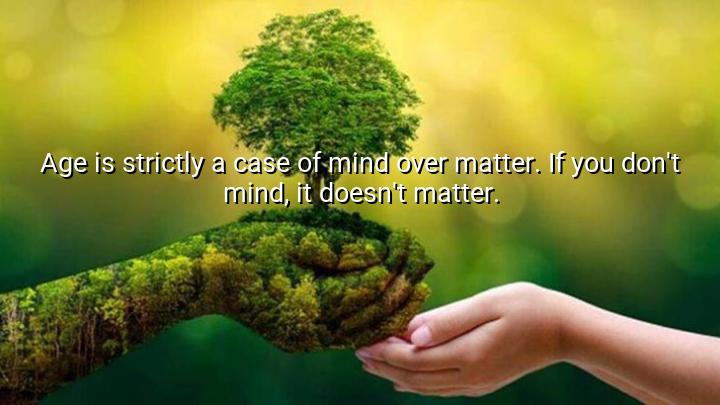




The quote "Age is strictly a case of mind over matter. If you don't mind, it doesn't matter," by Jack Benny, humorously highlights the idea that age is largely a mental concept. Rather than focusing on the physical signs of aging, the quote encourages us to adopt a mindset where age is irrelevant as long as we don't dwell on it. If we choose not to mind the number of years we've lived, it won't have a negative impact on our outlook or quality of life.
Jack Benny, a famous American comedian, is known for his witty sense of humor and his ability to use comedic timing to address common life topics. His use of humor to tackle the subject of aging reflects his belief that attitude plays a significant role in how we experience life, including the passage of time. Through this quote, Benny encourages a lighthearted approach to growing older, emphasizing that mental attitude is the true determinant of how we live.
The origin of this quote is rooted in Benny’s comedic style, where he often joked about his age, exaggerating it for comic effect. He would refer to himself as being much older than he actually was, poking fun at society’s obsession with youth and appearance. His message is clear: aging is not something to fear or stress about; it’s our perception of it that makes it either a burden or something to embrace.
Ultimately, Benny’s quote suggests that mindset is powerful. By choosing to focus on what truly matters—such as health, happiness, and relationships—age becomes irrelevant. It's a clever reminder that the best way to live a fulfilling life is to not let the passing years dictate how we feel or what we do.

PLPhu Le
What role does societal attitude play in whether or not we 'mind' aging? If people were celebrated more as they aged, maybe fewer would mind getting older. This quote puts the responsibility on the individual to have a positive outlook, but shouldn't society also carry some of that burden? I’m wondering if this is a gentle reminder of self-empowerment or a subtle critique of how we collectively handle aging.
N8Quach Ai Nhi 8a4
I can’t help but feel conflicted. I get the humor and the sentiment, but I’ve seen people truly suffer in old age—physically and emotionally. Can we really say that age 'doesn’t matter' if someone is experiencing dementia or deep loneliness? I appreciate the optimistic spin, but is it realistic? It sounds great on paper, but maybe we need a more balanced view that embraces both acceptance and practical support.
YPhoai yen pham
Is this quote actually about age, or is it more about how we let external labels define our self-worth? It seems like it's encouraging a kind of mental independence—refusing to let society’s expectations dictate how we feel about ourselves. If that’s the case, could this same idea be applied beyond age? Like to appearance, career status, or even failure? It feels deeper than it looks at first glance.
T_twien _
I love the humor here—it’s light, witty, and very Jack Benny. Still, I’m left wondering about cultural perspectives on aging. In some cultures, age is revered and associated with wisdom; in others, it's seen as something to hide or fix. Do people from more age-positive cultures resonate with this quote differently? I'd be interested in hearing how this perspective lands across different societies and generations.
NBNgan Bui
This quote made me smile, but I wonder—does it only apply to those who are privileged enough to age with good health and support? It feels optimistic, yet a bit idealistic. Not everyone can 'not mind' aging when it comes with chronic pain or financial struggles. Can attitude alone really shape the aging experience, or is this just a comforting idea for those who aren't facing the harder parts of getting older?