

Age is not all decay; it is the ripening, the swelling, of the fresh life within, that withers and bursts the husk.
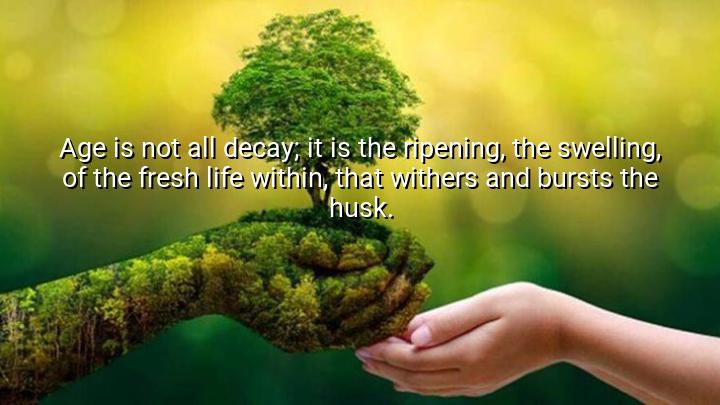




George MacDonald’s quote, "Age is not all decay; it is the ripening, the swelling, of the fresh life within, that withers and bursts the husk," offers an optimistic perspective on the process of aging. Rather than viewing age as merely a time of decline, MacDonald presents it as a phase where life continues to develop and mature, much like a fruit ripening. He suggests that aging involves the swelling of the inner vitality and potential that has been cultivated over time, symbolized by the process of the husk (or outer shell) being shed or "burst."
The quote draws an analogy between aging and the natural process of ripening, where outward appearance might deteriorate, but inward growth and wisdom intensify. MacDonald challenges the common belief that age leads only to deterioration, instead offering the idea that it can be a time for inner strength, maturation, and the fulfillment of one’s potential. The husk, which may refer to the superficial aspects of youth or material existence, is discarded to reveal the deeper, more profound aspects of life.
George MacDonald, a Scottish author, poet, and Christian minister, is best known for his works of fiction, including fairy tales and fantasy novels that often explored themes of growth, redemption, and spiritual maturity. His quote reflects his spiritual and philosophical views, where he often emphasized the importance of personal development and the inner life, particularly in relation to age and the passage of time.
In essence, MacDonald’s quote encourages a shift in perspective about aging. Instead of seeing age as simply the decline of physical faculties, he suggests that it represents a ripening of the inner life and wisdom. As we age, the husk of youthful appearance may fade, but the true vitality of the self—the wisdom, experience, and emotional depth—becomes more evident and transformative.

PATrinh Phuong Anh
As someone approaching middle age, this quote really resonates. I've started to feel changes—not just physically, but in how I understand the world. There's a clarity and depth I didn’t have in my 20s. Maybe that’s what MacDonald means by ripening. But I do wonder: does everyone experience this? Or is this a path we must consciously choose—to grow inward even as the outer shell fades?
PNquang phuc Nguyen
MacDonald's choice of words like 'ripening' and 'swelling' is striking—it evokes natural, almost sacred growth. It’s a gentle push to rethink our fear of aging. But I’m curious: does this metaphor imply that our true self isn't fully formed until later in life? If so, what does that say about the pressure society places on youth to figure everything out? It feels freeing, but also a little destabilizing.
TK15 Nguyen Thieu Khang
I love how this quote reframes age as a beginning rather than an end. It makes me wonder how we can live more in tune with this idea. What does it mean to nurture that 'fresh life within'? Could creative expression, spiritual reflection, or mentorship be forms of that inner swelling? I'd really like to believe that old age is not the final stage, but a revelation of something deeper.
ISIam Shiii
This quote feels poetic but also surprisingly profound. Could it be suggesting that aging brings us closer to our essence? Like we shed the outer distractions and reach something more authentic? I’d love to explore whether different cultures see age this way too. Are there societies that honor aging as a kind of spiritual emergence rather than just decline? I think we in the West could learn from that.
TTThuy Than
MacDonald's imagery really strikes me. The idea that aging isn't just about deterioration but a kind of inner transformation is deeply comforting. Still, I question whether this is universally true. What about those who face dementia, chronic illness, or emotional despair in later years? Can we still talk about ripening, or is that just a romanticized view? It's a lovely thought, but maybe a bit idealistic?