

Age is how we determine how valuable you are.
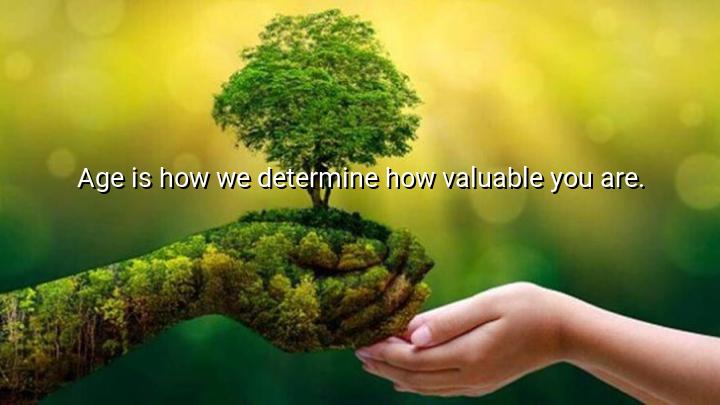




The quote "Age is how we determine how valuable you are" by Jane Elliot challenges the societal tendency to associate value with youth and age. Jane Elliot, an American educator and activist known for her work on race and discrimination, uses this statement to point out how society often places greater worth on the younger generation, particularly in terms of appearance, productivity, and cultural significance. The idea that a person’s value is determined by their age is a reflection of the widespread cultural bias that can lead to ageism.
Elliot’s quote highlights the often unfair and superficial way that people are judged based on their age. In many societies, youth is celebrated for its vitality, energy, and potential, while older individuals may be seen as less relevant or capable. This creates a hierarchy where older people, particularly those past a certain age, might feel marginalized or undervalued, despite the wisdom and experience they may bring to society.
The statement also reflects the subjective nature of how we assess a person’s worth. Age becomes a tool through which people are placed into categories of value, regardless of their individual contributions, knowledge, or character. By focusing on age, society misses the opportunity to recognize the full value of individuals, particularly older adults, who possess insights and experience that can greatly enrich communities and organizations.
Ultimately, Elliot’s quote calls attention to the age-based prejudices that permeate society, urging us to reconsider how we define a person’s worth. It challenges the common notion that age is the determining factor of value and encourages a more holistic and inclusive approach to evaluating individuals, recognizing their contributions, abilities, and human qualities regardless of their age.

TXNguyen Thanh Xuan
There’s something chillingly true in this statement. From job interviews to media roles to healthcare, we see age influence how people are treated. Why is there such a strong obsession with age as a status marker? Shouldn’t we be striving for a culture where every age is seen as valuable in its own right—offering something unique rather than being judged on a linear scale?
PANguyen Phuong Anh
I think this quote is meant to provoke, and it does. If we truly believe that age equals value, then who decides which ages matter most? Babies are celebrated, youth is idolized, and elders are often ignored. Isn’t this inconsistent and unfair? Maybe this quote is less a belief and more a critique of how we treat people across the lifespan. Either way, it’s thought-provoking.
BPBich phuong
Is Jane Elliot being sarcastic or brutally honest here? Either way, this quote stings. It implies that age has become a kind of currency that determines your relevance or respect in society. Shouldn’t we be pushing back against this and demanding that value be defined more holistically—by ideas, actions, and integrity rather than just a birth year?
QNPham Thi Quynh Nhu
This quote feels like a brutal mirror. It makes me wonder how much of our self-worth is shaped by how others perceive our age. Are we training young people to fear getting older because they’ll be seen as less important? Shouldn’t we be building systems that honor experience and resilience instead? Ageism is so ingrained that we barely notice it—until we’re on the receiving end.
A-DUONG VIET AN -7B
Reading this made me question how often we unconsciously apply this standard. Think about job markets, fashion, even media representation—youth is glorified, and aging often becomes a reason to sideline someone. Why do we tie someone’s usefulness or significance to their age? Shouldn’t society evolve beyond such a shallow metric? It’s time we challenge these norms and ask who gets to define value anyway.