

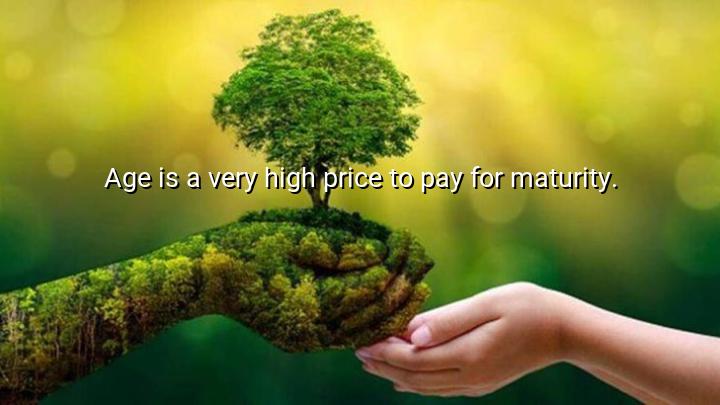
Age is a very high price to pay for maturity.




In this witty quote, Tom Stoppard reflects on the relationship between age and maturity, suggesting that the price of becoming more mature is the inevitability of aging. The phrase "a very high price" implies that growing older comes with physical decline, loss, and other challenges that may seem disproportionate to the gains in wisdom and self-awareness that maturity brings. Stoppard's words express a sense of irony, as maturity is often seen as a desirable trait, but it comes at the cost of the youthful vitality we once had.
Stoppard’s quote points to the sacrifices that come with age, as the process of growing older often brings more than just wisdom—it brings a loss of physical energy, health, and youthful opportunities. While maturity may grant us greater insight and understanding, it often does so by demanding the vibrancy and time that come with being young. Thus, the quote captures the paradox of aging: we gain wisdom, but we lose the freedom and strength associated with youth.
This idea also emphasizes the trade-off between living life with spontaneity and carefree enjoyment in youth, and the more calculated and sometimes burdened approach that comes with maturity. The price of maturity, according to Stoppard, is the realization that youth and the infinite possibilities it holds are finite, and once lost, cannot be reclaimed.
Ultimately, Stoppard’s quote encourages reflection on the duality of life: the more we gain in wisdom and experience, the more we pay in terms of time and physical well-being. It invites us to consider whether the price of maturity is truly worth the wisdom it brings, or if the carefree days of youth hold a value that can never be matched.

MTNguyen Minh Thu
Is this quote poking fun at how slow the process of growing up really is? It almost sounds like a complaint—that we pay with our youth for the luxury of wisdom. That raises a tough question: if we could keep our youthful energy and naivety forever, would we want to? Or is maturity something we only learn to appreciate once we’ve aged enough to see its value?
AVNguyet Anh Vu
Tom Stoppard’s quote makes me question how we define growth. Is it fair that wisdom often comes only after loss, disappointment, or long years of struggle? I wonder if maturity has to be earned through suffering, or if it’s possible to nurture it intentionally through education, reflection, or mindfulness. Does aging just provide more context—or is it a requirement for understanding life’s deeper truths?
MDMinh Dang
This line feels like a sharp commentary on the human experience. Do we overvalue maturity at the expense of playfulness, spontaneity, or even joy? Why is maturity often associated with restraint and seriousness rather than curiosity or creativity? I’d love to hear if people believe that aging always leads to maturity—or can someone stay immature no matter how old they are?
TPTrann Pham
I find this quote both clever and a bit depressing. It’s like saying we spend half our lives learning how to live, only to realize too late that youth is gone. Is maturity really worth the cost if we lose our vitality along the way? Or maybe it’s a critique of how society measures growth—perhaps we should be rethinking what it means to be mature in the first place?
NTAnh Duong Nguyen Thi
This quote really hits home. It makes me wonder—why does maturity have to be so closely tied to aging? Are there no shortcuts, no way to achieve wisdom and perspective without sacrificing youth? It’s almost tragic to think that by the time we figure out life, so much of it has already passed. Is there a way to cultivate emotional intelligence earlier without having to go through decades of trial and error?