

Age is a matter of feeling, not of years.
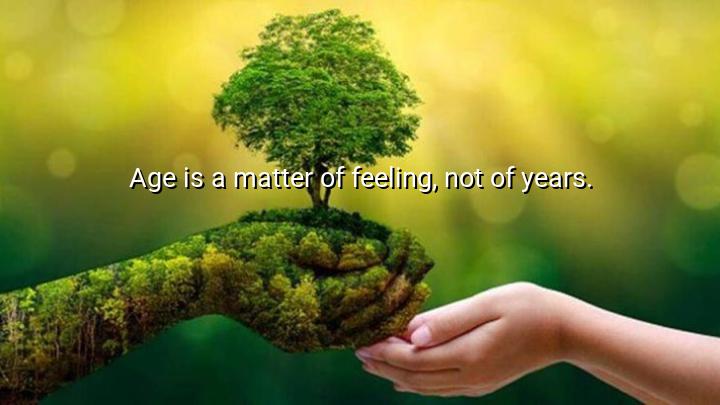




Washington Irving’s quote, "Age is a matter of feeling, not of years," suggests that the way we experience age is not solely determined by the number of years we live but by how we feel mentally, emotionally, and physically. Irving implies that one’s sense of age is influenced more by internal factors, such as energy, outlook on life, and personal vitality, rather than the chronological passage of time. In this view, a person can feel young or old regardless of their actual age.
The quote challenges the conventional notion that age is strictly defined by years, emphasizing instead that feeling young or old is a subjective experience. Age is often associated with physical limitations or societal expectations, but Irving’s perspective suggests that individuals can transcend these limitations if they maintain a youthful mindset or approach life with enthusiasm, curiosity, and resilience.
Washington Irving, an American author best known for works like The Legend of Sleepy Hollow and Rip Van Winkle, often explored themes of personal identity, time, and transformation. This quote reflects Irving's belief in the fluidity of time and his understanding of how people experience their lives in non-linear, personal ways. It echoes a sentiment that transcends the physical realm and touches on the psychological aspects of living.
In essence, Irving’s quote encourages a rethinking of age and challenges the idea that it is strictly tied to physical years. It proposes that feeling young or old depends on one’s mental and emotional attitude, making the experience of age more flexible and personal. Youthfulness, in this context, is not about a number but about maintaining a lively and engaged spirit throughout life.

TVThanh Vy
I agree with the sentiment, but I wonder how much control we really have over how old we feel. Hormones, chronic pain, fatigue—these things affect how we perceive ourselves, no matter how optimistic we try to be. So while the idea is inspiring, I think it also risks minimizing the real struggles that come with aging.
HDHuy Dinh
This quote is refreshing. It challenges the notion that age automatically means decline or irrelevance. But it also makes me curious—what factors help people maintain that youthful feeling? Is it mindset, lifestyle, relationships, purpose? And can those things be cultivated, or are they more about circumstance and privilege?
ATTruong Anh Toan
It’s a romantic idea, and one I want to believe. But I’m conflicted. Feeling young doesn’t always translate into being physically able to do what you once did. Is this quote an uplifting truth or a kind of denial? How do we reconcile the youthful spirit within us with the very real limitations age can bring over time?
NVKhanh Ngoc Vu
I love the optimism in this statement. It suggests we have some control over how we experience growing older. But it also raises a question: do societal expectations influence how we 'feel' about our age? For instance, if we're constantly told we should slow down at a certain age, do we start to internalize that regardless of how we actually feel?
HDHuong Duyen
This quote really speaks to me. It makes me wonder if aging is more psychological than physical in many ways. I've met people in their 70s with more zest for life than some in their 30s. But then again, can we truly separate feeling from the reality of declining health or energy? Is this mindset empowering or does it risk ignoring real challenges older people face?