

Age does not matter if the matter does not age.
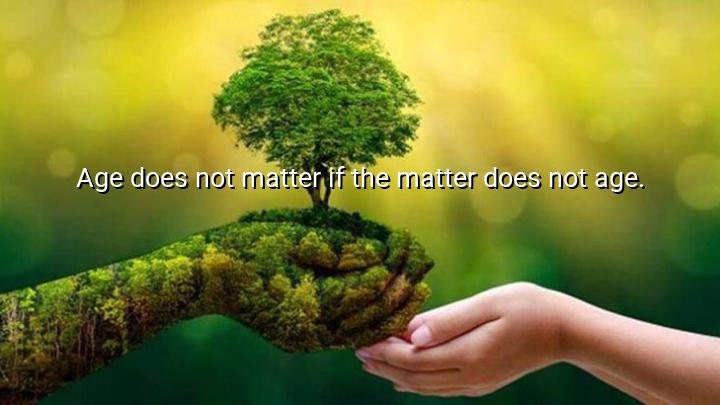




In this quote, Jean Paul suggests that age is irrelevant if the substance or essence of a person or thing remains unchanged. He implies that what truly matters is the quality or nature of a person or their work, rather than the passage of time. In this sense, if the core of something—whether it’s a person’s abilities, ideas, or creative output—remains vibrant and strong, then age should not be seen as a limitation or concern.
Jean Paul’s words reflect the idea that certain qualities or talents can be timeless. For example, a person’s wisdom, creativity, or passion might not be diminished by the passage of time, even though their age increases. In this way, the value of a person or thing is tied to its enduring qualities, rather than its physical condition or chronological age.
This quote also speaks to the idea of immortality through one’s work or influence. It suggests that if someone creates something of lasting significance—be it art, philosophy, or innovation—that work can outlast the individual, remaining valuable long after their physical age has advanced. The quote is a reminder that legacy and meaning are not bound by age, but by the lasting impact of one's contributions.
Ultimately, Jean Paul encourages us to focus on the substance of life, whether in ourselves or in others, rather than being preoccupied with the superficial passage of time. His message is one of endurance, suggesting that true value comes from the qualities that persist beyond age, rather than the number of years lived.

MHNGUYEN MINH HANG
Isn’t it interesting how this quote could also relate to science or technology? Some materials, like gold or diamonds, hardly age—so they’re prized across centuries. Could the same be said for ideas or values that don’t degrade over time? I wonder if this is a challenge for us to invest in things that last—whether that’s principles, relationships, or innovation that withstands the erosion of time.
MDMy Duyen
As someone who's often anxious about getting older, this quote actually brought me comfort. Maybe it’s a reminder that if we keep our passions alive and stay mentally and emotionally active, age doesn’t define us. I’m curious though—can society ever truly look past numerical age? Or will ageism always persist regardless of how 'unaged' the matter is?
NKnguyen nam khanh
Do you think this quote could be applied to love or friendship? Sometimes, relationships that are decades old still feel fresh and full of life, while others become stale quickly. So maybe what’s really important is whether the core—the 'matter'—keeps growing, evolving, and engaging. I think this speaks to the idea of emotional or spiritual renewal being more important than chronological aging.
Q_Phuong Quyen _8B
I find this line quite poetic, but also philosophical. Is it saying that the essence of something—its 'matter'—is what truly defines its significance, not the passage of time? It reminds me of how some people or concepts never seem to get 'old' no matter how much time passes. Could this be why some art, literature, or wisdom remains timeless while other things fade quickly?
BHtam bui huy
This quote intrigues me—does it imply that age is only relevant when something starts to deteriorate? It makes me wonder about how we define vitality or relevance in people, ideas, or even relationships. If something remains vibrant or meaningful, should its 'age' even be a factor? I’d love to hear perspectives on whether society puts too much weight on age, especially in careers or creativity, when perhaps energy and value matter more.