

A shan-shui city is a modern city, a high-density urban situation, but we pay more attention to the environment. We bring waterfalls; we bring in a lot of trees and gardens. We treat architecture as a landscape.
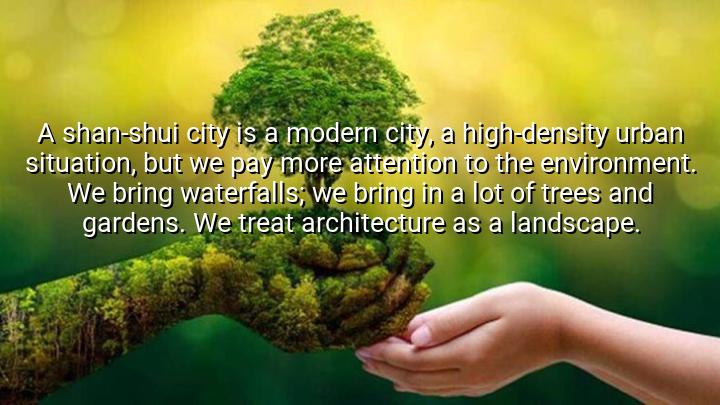




Ma Yansong’s quote introduces his visionary concept of the "shan-shui city", which redefines how we think about urban development by integrating nature into the heart of modern city planning. A shan-shui city—literally meaning "mountain-water" in Chinese—combines the high-density characteristics of contemporary cities with a strong emphasis on the environment. By saying, “we bring waterfalls; we bring in a lot of trees and gardens,” Ma illustrates his goal of softening the urban fabric with natural elements that enhance well-being, aesthetic beauty, and ecological harmony.
The statement “we treat architecture as a landscape” captures the core of Ma’s design philosophy, where buildings are not isolated, rigid objects, but extensions of the natural world. Rather than imposing artificial structures on the environment, his approach seeks to blend architecture with topography, allowing the built environment to coexist with mountains, water features, greenery, and open space. This approach challenges traditional Western urbanism and reflects a philosophical return to ancient Chinese ideals that value the interdependence of people and nature.
Ma’s concept of the shan-shui city is more than just visual—it is cultural and spiritual. It stems from traditional Chinese landscape painting, where nature, humanity, and architecture are depicted as parts of a unified whole. His work through MAD Architects strives to realize these principles in the 21st century, creating urban spaces that are not only efficient and futuristic but also emotionally resonant and deeply human. This philosophy guides projects such as the Harbin Opera House and the Chaoyang Park Plaza, where buildings resemble natural formations and seamlessly interact with their surroundings.
This quote comes from Ma Yansong’s public lectures, writings, and interviews where he discusses his long-term vision for more sustainable and poetic urbanism. By fusing contemporary architecture with cultural heritage and environmental consciousness, Ma’s shan-shui city model offers a new paradigm for urban development—one that promotes balance, beauty, and spiritual connection in the face of growing urban sprawl.

AAdministratorAdministrator
Welcome, honored guests. Please leave a comment, we will respond soon