

A graceful and honorable old age is the childhood of immortality.
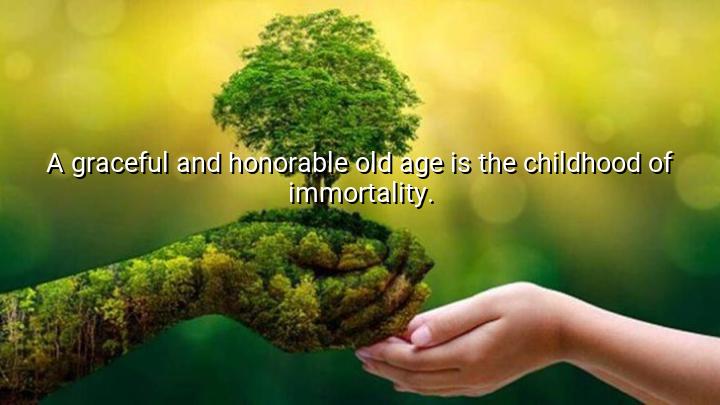




In this quote, Pindar, an ancient Greek poet, suggests that old age, when experienced with grace and honor, is akin to the childhood of immortality. He compares old age to a beginning stage, much like childhood, but in the context of an eternal existence. This implies that the way we live in our later years—how we carry ourselves with dignity and respect—has the potential to shape our legacy or spiritual immortality, offering a kind of eternal life through how we are remembered or how we transcend time.
Pindar’s use of grace and honor in this context suggests that a person’s character and integrity in their later years are what give life meaning, elevating the process of growing old into something noble rather than something to be feared or avoided. By framing old age in this way, Pindar emphasizes the importance of living well, with virtue, throughout one's life, as this contributes to one’s immortality through the memory left behind or the influence they have on future generations.
The quote also reflects the idea that in old age, if one has lived a life of wisdom and virtue, they have already laid the foundation for something enduring. Pindar uses childhood as a metaphor for the beginning of a journey, where immortality can be achieved not through physical means but through a legacy of actions and character that resonate beyond the temporal world.
Ultimately, Pindar’s quote presents old age as a stage of life that can be meaningful and even transcend the limitations of time, as long as it is lived with the values of grace and honor. It encourages us to view aging not as a decline, but as a vital part of a larger journey toward something eternal—immortality achieved through the virtues we embody and pass on to future generations.

VANguyen Viet Anh
Is this quote really about aging, or is it more about the way we live throughout our lives? Maybe 'graceful and honorable' old age is the result of decades of choices, not something that just appears with time. That raises an interesting question: can someone live carelessly and still grow into an honorable old age? Or is this a reward earned only by those who’ve cultivated dignity over a lifetime?
NBNgan Bao
This makes me reflect on the idea that aging isn't an end but a transition. Do you think people today still view old age with that kind of reverence? It seems like modern culture often fears aging rather than embracing it as sacred or noble. Has society lost touch with this wisdom, or is there still a space where we honor age as something transcendent? I’d love to believe Pindar’s view still holds true today.
G5luffy gear 5
I find this quote deeply comforting, but also a little idealistic. What about those who age without support or health—are they excluded from this 'childhood of immortality'? Can one still live honorably and gracefully under hard conditions, or is this a luxury only some people can afford? I guess I’m questioning how accessible this ideal of aging really is across different lives and circumstances.
THThanh Hoai
Is this suggesting that living with dignity in old age somehow prepares us for eternity, whatever form that might take? It makes me think about how different cultures view aging. Some see it as decline, others as ascension. I’d love to hear more interpretations of what 'immortality' means here. Is it literal, symbolic, or maybe even a poetic ideal of how one is remembered or spiritually fulfilled?
NNngoc nhu
This quote gives me chills—it’s such a beautiful and profound way to view aging. But I wonder: what defines 'graceful and honorable' in old age? Is it how we treat others, how we carry ourselves, or how we reflect on our past? And what does it mean for old age to be the beginning of something eternal? Is Pindar speaking spiritually, or is he talking about the legacy we leave behind?