

You should always take a religion at its best and not at its worst, from its highest teachings and not from the lowest practices of some of its adherents.
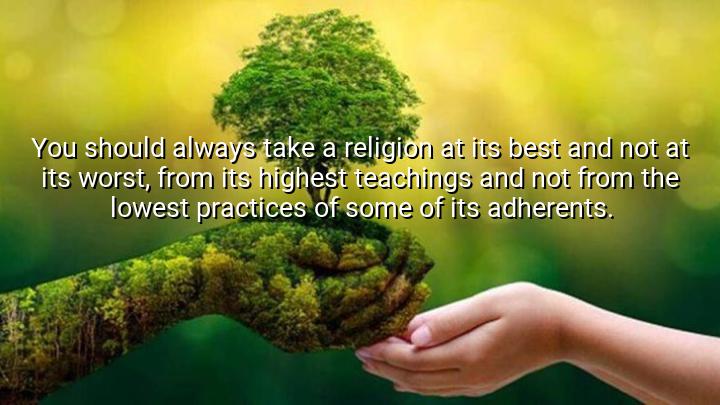




Annie Besant's quote emphasizes the importance of interpreting religion in its most positive and ideal form, rather than judging it based on the actions of a few individuals or its misuse by others. She suggests that the essence of any belief system is found in its highest teachings, which promote universal values such as love, compassion, and justice. By focusing on these ideals, one can appreciate the true spiritual message of the religion, free from the distortions caused by human imperfections.
Besant is advocating for a deeper understanding of religion, one that is not swayed by extremist views or the misinterpretations that often arise due to individual biases or actions. She reminds us to differentiate between the core spiritual teachings of a religion and the negative practices or flaws of its followers. In doing so, we are encouraged to look beyond the human shortcomings and focus on the universal truths that bind religious philosophies together.
This perspective is rooted in Besant's own experiences as a prominent theosophist and a social reformer, where she encountered various religions and spiritual practices across the world. She advocated for a more inclusive approach to religion, urging followers of different faiths to recognize and celebrate the common spiritual ground shared among them, rather than focusing on the differences that divide.
Ultimately, Besant's words are a call for more tolerance, understanding, and a commitment to seeing religions in their best light, as forces for good that can contribute to the moral and ethical development of humanity.

AAdministratorAdministrator
Welcome, honored guests. Please leave a comment, we will respond soon