

You can't choreograph death, but you can choreograph your funeral.
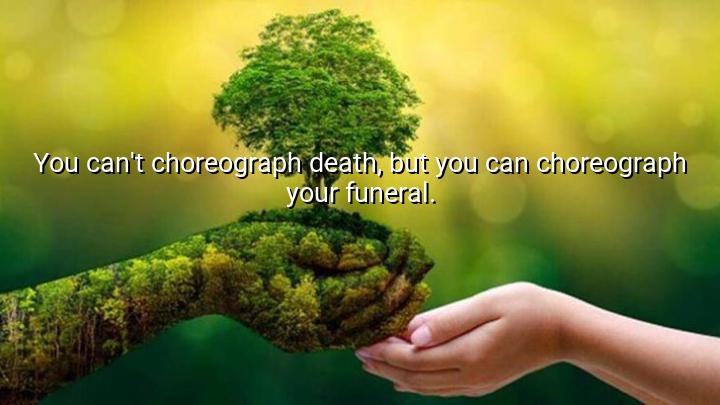




In this quote, Marina Abramovic, a pioneering performance artist, reflects on the concept of control over life and death. She begins by stating that death cannot be planned or choreographed, as it is beyond human control and unpredictable. The finality of death is something that cannot be manipulated or anticipated in the way that a performance or event can. However, she contrasts this with the idea that while we cannot control the moment of death, we do have the ability to choreograph our funeral, symbolizing a way to exert some control over how we are remembered or honored after our passing.
The idea of choreographing one's funeral suggests the power of personal agency in the way we shape our legacies. While we may not have control over the circumstances of our death, we can still influence how our lives and memories are celebrated or commemorated. This can extend to rituals, artistic representations, or even the legacy we leave behind through our actions and contributions during our lifetime. Abramovic, known for her immersive and often intense performance art, likely views this as a form of artistic expression, even in death, where one’s final moments and rituals can be as deliberate and meaningful as any of their performances.
Abramovic’s work often explores themes of endurance, identity, and the relationship between the performer and the audience. Her statement may also hint at the idea that, in her eyes, art and performance can transcend life, continuing in different forms, even after death. The act of choreographing one's funeral might also reflect a deeper philosophical belief in the importance of intentionality in life and death—ensuring that the story we leave behind is as purposeful and meaningful as the acts we perform during our lives.
The origin of this quote is rooted in Abramovic's focus on the intersection of life, art, and death. As an artist, she has long been fascinated by the transcendent and ephemeral nature of existence, often engaging with these themes in her performances. Her remark on choreographing one’s funeral is a natural extension of her views on the performative nature of existence, where even the most final moments can be shaped by intention and artistic expression.

AAdministratorAdministrator
Welcome, honored guests. Please leave a comment, we will respond soon