

Happiness is such a good state, it doesn't need to be creative. You're not creative from happiness, you're just happy. You're creative when you're miserable and depressed. You find the key to transform things. Happiness does not need to transform.
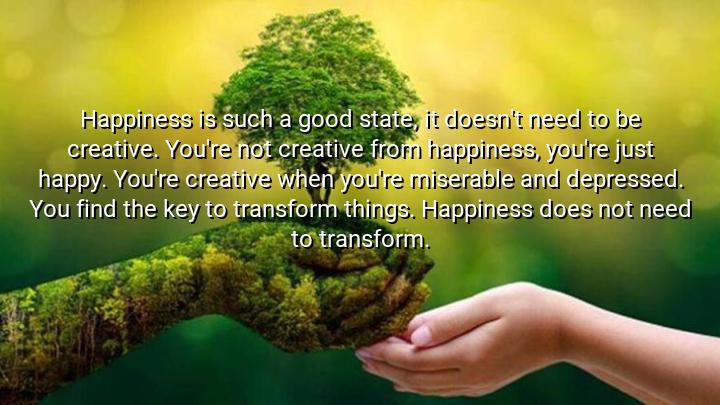




The quote by Marina Abramović — "Happiness is such a good state, it doesn't need to be creative. You're not creative from happiness, you're just happy. You're creative when you're miserable and depressed. You find the key to transform things. Happiness does not need to transform." — explores the relationship between creativity and emotional states, particularly the contrast between happiness and negative emotions like misery and depression. Abramović, a Serbian performance artist known for her avant-garde and often intense work, suggests that happiness does not require creativity because it is a state of contentment and completeness that doesn't need to be altered or transformed.
In contrast, she argues that creativity often arises in moments of struggle or emotional discomfort. According to Abramović, when people are experiencing misery or depression, they are driven to find a way to transform their feelings or circumstances, and this process of transformation is where creativity thrives. Negative emotions push individuals to explore new solutions, ideas, and artistic expressions as a way of coping or making sense of their inner turmoil.
Abramović’s statement reflects her own experiences as an artist, where she has often drawn from personal suffering and emotional intensity to fuel her creative work. In her view, creativity is not born from happiness because happiness, by nature, is stable and does not require change or innovation. It is in the darker, more challenging emotional states that the need for transformation emerges, motivating individuals to express themselves and find new ways of seeing or interpreting the world.
In essence, Abramović’s quote presents a provocative view on the role of emotion in the creative process. While happiness is a fulfilling and desirable state, it does not stimulate creativity in the same way that misery or depression can, because it does not drive the need to change or create. This perspective challenges the conventional belief that creativity thrives on positive energy, instead suggesting that pain and struggle are often the true catalysts for artistic innovation and transformation.

AAdministratorAdministrator
Welcome, honored guests. Please leave a comment, we will respond soon