

Why do I talk about the benefits of failure? Simply because failure meant a stripping away of the inessential. I stopped pretending to myself that I was anything other than what I was, and began to direct all my energy into finishing the only work that mattered to me.
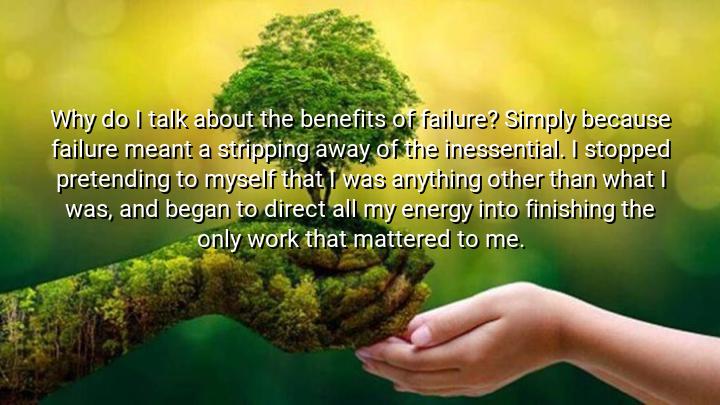




In this quote, J.K. Rowling reflects on the benefits of failure and how it served as a transformative experience in her life. She suggests that failure was pivotal because it led to the stripping away of the inessential, meaning that it helped her let go of distractions and focus on what truly mattered. Instead of being bogged down by external pressures or societal expectations, failure forced her to confront her true self and gain clarity about her priorities.
Rowling also acknowledges that failure helped her stop pretending or trying to be something she wasn't. Before experiencing failure, she may have been caught up in the illusion of success or trying to live up to certain expectations. But through failure, she came to terms with her real identity and stopped trying to live up to an image that didn’t align with her authentic self. This self-awareness enabled her to channel her energy into the pursuit of her true passion—writing.
By focusing on the work that truly mattered to her, Rowling was able to direct all her energy into creating something meaningful. In her case, that work was writing, which ultimately led to her success as the author of the Harry Potter series. Her experience shows how failure can be a turning point that helps individuals realign their efforts toward what is most important and fulfilling, rather than pursuing superficial goals.
Ultimately, Rowling’s quote emphasizes the positive impact of failure. Rather than viewing it as a defeat, she sees it as a valuable experience that stripped away the unnecessary and led her to a place of personal truth and focus. Failure, in her view, was a necessary step in the process of achieving meaningful success and pursuing her passion.

AAdministratorAdministrator
Welcome, honored guests. Please leave a comment, we will respond soon