

Who has fully realized that history is not contained in thick books but lives in our very blood?
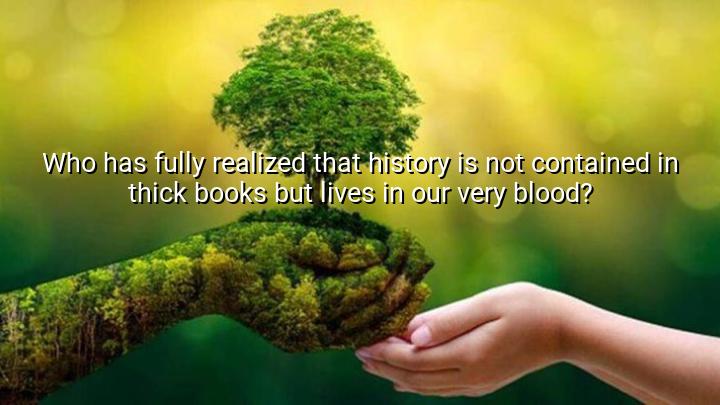




In this quote, Carl Jung, the Swiss psychiatrist and founder of analytical psychology, suggests that history is not just a collection of facts and dates found in books, but something that is deeply embedded within the very essence of who we are. He proposes that history is not confined to written records but is passed down through generations, shaping our thoughts, behaviors, and collective unconscious. Jung is emphasizing the idea that human experience and the lessons of the past live within us, influencing our actions, decisions, and interactions in ways we may not even be consciously aware of.
Jung’s quote challenges the conventional understanding of history as something external, taught through books or lectures, and instead invites us to see it as a living force that flows through our bloodline. It speaks to the unconscious influence of past events on our present selves, especially in terms of cultural memory, ancestral trauma, and collective identity. History, in this sense, is not static or merely academic but an ongoing force that shapes our collective consciousness and personal identities.
The origin of this quote comes from Jung’s work on the collective unconscious, a theory that suggests that humans share a collective memory of past experiences that affect our behavior and perceptions, even if we are unaware of it. Jung believed that these shared experiences were encoded in the unconscious mind and passed down through cultural symbols, myths, and traditions. This quote reflects his broader belief that history is more than just external knowledge—it is an internal, living part of the human psyche.
Ultimately, Jung’s quote urges us to reconsider our understanding of history as something passive that we study from books and recognize it as something active that shapes our identity, actions, and worldview. It calls for a deeper connection to the past, acknowledging that history is not merely recorded in texts but is alive within us, influencing how we perceive and interact with the world.

AAdministratorAdministrator
Welcome, honored guests. Please leave a comment, we will respond soon