

What's interesting about architects is, we always have tried to justify beauty by looking to nature, and arguably, beautiful architecture has always been looking at a model of nature.
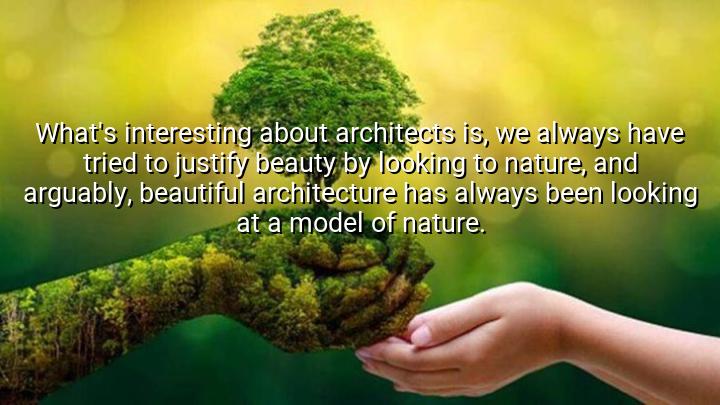




The quote by Greg Lynn, “What’s interesting about architects is, we always have tried to justify beauty by looking to nature, and arguably, beautiful architecture has always been looking at a model of nature,” reflects a deep philosophical link between natural forms and architectural aesthetics. Lynn, a leading figure in contemporary architecture and digital design, emphasizes how architects have historically grounded their pursuit of beauty in the patterns, logic, and elegance of the natural world. Rather than viewing beauty as a subjective or decorative quality, architects often seek validation by aligning it with biological, geometric, or organic structures found in nature.
The idea that architecture models nature speaks to centuries of tradition, from classical architecture inspired by proportion and symmetry, to Gothic cathedrals mimicking the complexity of trees, and more recently, biomimicry in digital and sustainable design. By referencing nature, architects find a universal language of form that resonates on both emotional and intellectual levels. Lynn suggests that the most compelling architecture doesn’t just imitate nature’s appearance—it channels its systems, dynamics, and efficiency.
Lynn’s own work has been influential in pushing architecture into a digital era, using computer modeling to create fluid, non-linear forms that closely resemble natural morphologies. His designs, such as the Embryological House, demonstrate how technology allows architects to mimic the variability and adaptability of nature in ways never before possible. In this context, his quote also reflects how contemporary architects use both ancient principles and cutting-edge tools to explore the intersection of beauty, form, and nature.
This quote likely comes from one of Lynn’s lectures or interviews, where he frequently discusses the evolution of form-making and the philosophical roots of architectural design. It serves as both a reflection on historical precedent and a commentary on current practice—reminding us that, despite changes in materials and methods, nature remains a timeless muse for the architectural imagination.

AAdministratorAdministrator
Welcome, honored guests. Please leave a comment, we will respond soon