

What's happened with society is that we have created these devices, computers, which already can register and process huge amounts of information, which is a significant fraction of the amount of information that human beings themselves, as a species, can process.
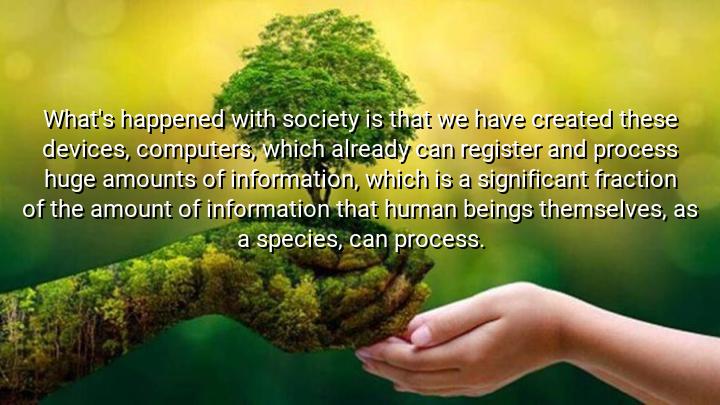




The quote, "What's happened with society is that we have created these devices, computers, which already can register and process huge amounts of information, which is a significant fraction of the amount of information that human beings themselves, as a species, can process," comes from Seth Lloyd, a professor of mechanical engineering and computer science at the Massachusetts Institute of Technology (MIT). In this statement, Lloyd reflects on the rapid evolution of computers and their ability to handle vast amounts of information, a task that was traditionally a hallmark of human cognitive abilities. He acknowledges that modern computers can process a significant fraction of the data that humans themselves can process, which highlights both the advancement of technology and its potential to complement or even augment human abilities.
The origin of this quote lies in Lloyd’s research in the field of quantum computing and his exploration of the intersection between computation and human cognition. He is emphasizing how machines have become incredibly adept at handling large volumes of data—something that, in the past, was exclusive to human minds. As computers continue to evolve, they are increasingly able to process more complex tasks that were once thought to be within the sole domain of human intelligence. This shift has significant implications for fields like artificial intelligence, data analysis, and even neuroscience.
In a broader context, the quote underscores the profound impact of computers on society and our relationship with technology. The ability of computers to process large amounts of information far exceeds the capabilities of individual human brains, which raises important questions about how human beings interact with machines and how this interaction may evolve. The statement touches on the co-evolution of technology and humanity, suggesting that while machines can enhance our capabilities, they also change the way we approach information and knowledge.
Ultimately, Lloyd’s quote is a reflection on the power of technology and its growing ability to perform tasks that once required human cognitive power. It challenges us to think about how computers can continue to enhance human creativity, problem-solving, and decision-making, while also raising concerns about how these advancements might impact our understanding of intelligence and human potential in the digital age.

AAdministratorAdministrator
Welcome, honored guests. Please leave a comment, we will respond soon