

What you possess in the world will be found at the day of your death to belong to someone else. But what you are will be yours forever.
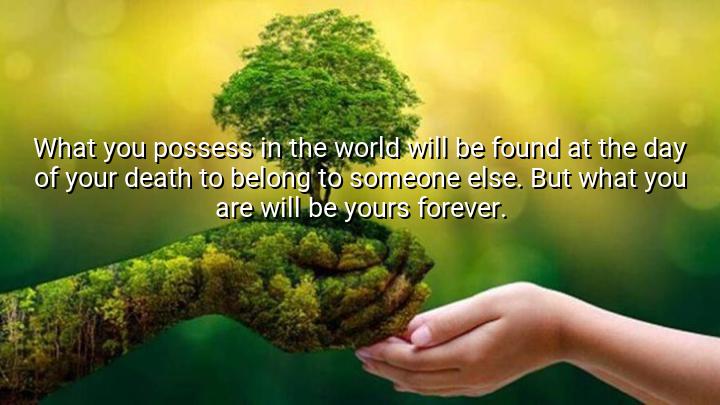




The quote, "What you possess in the world will be found at the day of your death to belong to someone else. But what you are will be yours forever," by Henry Van Dyke, reflects the idea that material possessions and wealth are temporary and ultimately fleeting. At the moment of death, all the things we accumulate in life will be passed on to others, as we cannot take them with us. In contrast, the person we become—the essence of our character, virtues, and integrity—remains with us eternally, beyond our physical life.
Van Dyke’s quote draws a clear distinction between the temporary nature of material success and the enduring value of one’s inner qualities. He emphasizes that while possessions can be lost or transferred, what we truly are—our values, wisdom, and moral fiber—cannot be taken away. This speaks to the importance of focusing on personal growth and character development, rather than the accumulation of things that offer only temporary satisfaction.
The origin of the quote is rooted in the philosophical and spiritual themes often explored by Henry Van Dyke, who was an American writer, poet, and clergyman. His work frequently dealt with questions of life, death, and eternal truth, aiming to inspire readers to live with purpose and integrity. This quote is a reminder that while we may leave behind physical possessions, our legacy—shaped by the way we lived and the person we became—lasts far longer.
Ultimately, Van Dyke’s message encourages individuals to prioritize the development of character over the pursuit of material wealth, reminding us that what we are as human beings has lasting value. Our actions, choices, and legacy are what define us and will continue to influence the world even after we are gone.

AAdministratorAdministrator
Welcome, honored guests. Please leave a comment, we will respond soon