

Weep not that the world changes - did it keep a stable, changeless state, it were cause indeed to weep.
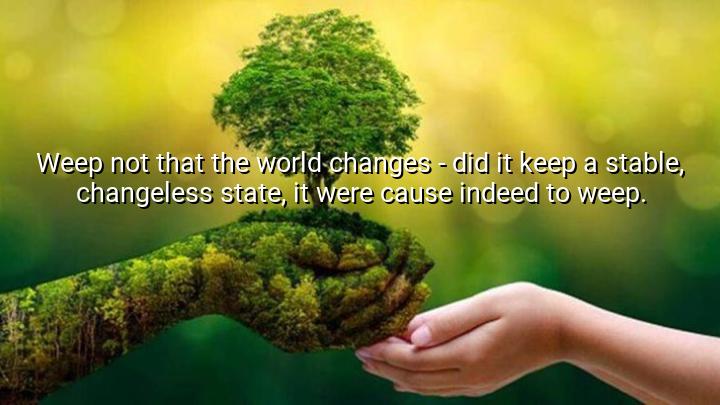




The quote, “Weep not that the world changes—did it keep a stable, changeless state, it were cause indeed to weep,” is attributed to William Cullen Bryant, a prominent 19th-century American poet, journalist, and editor. Known for his reflective and often philosophical poetry, Bryant frequently wrote about nature, time, and the human experience. This quote reveals his deep appreciation for the inevitability and value of change.
Bryant encourages us not to mourn the fact that the world changes, but to see this transformation as a natural and necessary part of life. In his view, change signifies growth, renewal, and progress. The real tragedy, he suggests, would be a world that remains static and unchanging—a world where nothing evolves, and life stagnates. That, more than anything, would be a reason for sorrow.
This perspective challenges the common human instinct to resist change out of fear or discomfort. Bryant reframes impermanence as something to embrace rather than avoid. Just as the natural world undergoes cycles of seasons, life too must shift and adapt to remain vibrant and meaningful.
Ultimately, the quote serves as a poetic reminder that change is not only inevitable, but also essential to the beauty and complexity of existence. Bryant’s words encourage us to accept the fluid nature of the world and to find hope and inspiration in its constant evolution, rather than clinging to the illusion of permanence.

AAdministratorAdministrator
Welcome, honored guests. Please leave a comment, we will respond soon