

We fear death so profoundly, not because it means the end of our body, but because it means the end of our consciousness - better to be a spirit in Heaven than a zombie on Earth.
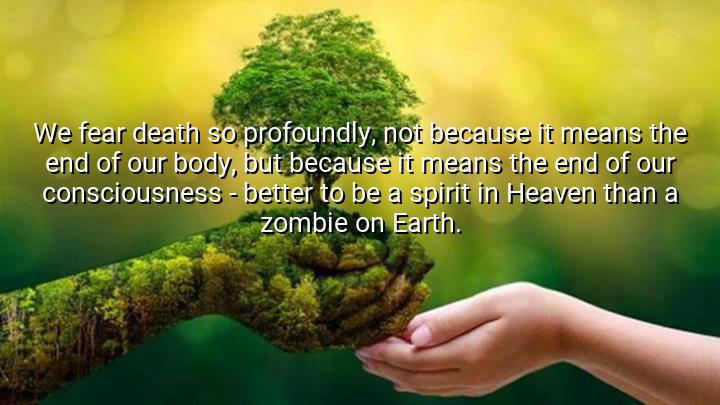




In this quote, Alison Gopnik, a renowned developmental psychologist and philosopher, delves into the psychological and philosophical nature of death and consciousness. She argues that the fear of death is not rooted in the physical cessation of the body but in the end of consciousness—the unique awareness we experience as living beings. According to Gopnik, what people truly fear is the loss of their ability to perceive, think, and experience the world, rather than just the death of the body itself.
Gopnik contrasts the concept of being a spirit in Heaven with being a zombie on Earth. She suggests that the idea of continuing to exist in a spiritual form—where consciousness persists—might be more desirable than a lifeless existence without awareness, such as that of a zombie. The metaphor of a zombie, with its lack of consciousness, highlights how the essence of being human lies in our awareness and ability to experience life, rather than in mere physical existence.
The quote also reflects broader existential concerns about the nature of identity and consciousness. Gopnik's perspective implies that our understanding of life and death is deeply connected to the ability to reflect, feel, and understand—qualities that define our human experience. The fear of losing these capacities makes the end of consciousness a profound and existential threat.
Ultimately, Alison Gopnik's quote speaks to the existential fear many people have regarding the finality of death. It challenges the traditional notion that death is merely the end of life, emphasizing instead that it represents the loss of the conscious experience of living, which is central to our sense of self and existence.

AAdministratorAdministrator
Welcome, honored guests. Please leave a comment, we will respond soon