

We do not know what love is. We know the symptoms of it, the pleasure, the pain, the fear, the anxiety and so on. We try to solve the symptoms, which becomes a wandering in darkness. We spend our days and nights in this, and it is soon over in death.
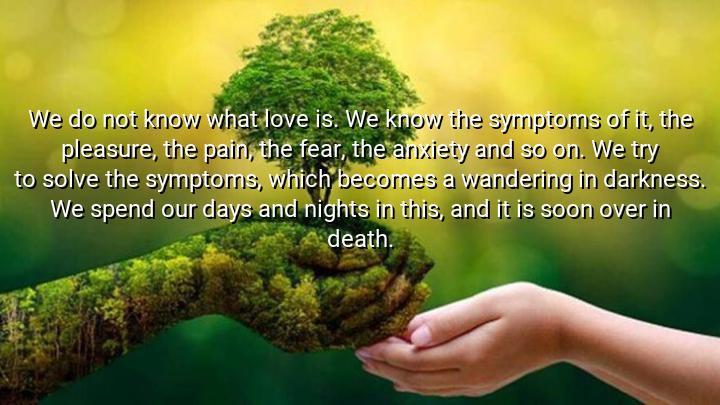




In this quote, Jiddu Krishnamurti, an Indian philosopher and spiritual teacher, reflects on the nature of love and the confusion surrounding it. He suggests that while we may experience the symptoms of love—such as pleasure, pain, fear, and anxiety—we do not truly understand what love itself is. Instead of seeking to understand the true essence of love, he argues that we often focus on managing or solving these emotions that arise, which leads us to wander in darkness, lost and without true understanding.
Krishnamurti’s statement highlights the human tendency to react to the emotional symptoms of love, without questioning the root cause or essence of those feelings. He critiques this pattern of behavior, where people focus on trying to fix the emotional responses—like fear or anxiety—rather than engaging in a deeper understanding of love. This kind of approach, he suggests, only leads to a cycle of confusion and frustration, where the true meaning of love is never fully grasped.
The quote also conveys a philosophical perspective on the transient nature of human life. Krishnamurti points out that our lives are spent trying to solve the symptoms of love, yet this pursuit often remains unresolved, and in the end, death comes, leaving us with little more than unfulfilled emotional struggles. By acknowledging the impermanence of life, he encourages a more profound exploration of love beyond its superficial manifestations, urging us to transcend the emotional chaos and understand love in its truest form.
Ultimately, Jiddu Krishnamurti’s quote challenges us to reconsider our understanding of love. It calls for a deeper reflection on its essence, beyond just the emotional highs and lows we experience. Through this, he encourages us to move away from a reactive approach to love and seek a more enlightened and self-aware understanding of this powerful human experience.

AAdministratorAdministrator
Welcome, honored guests. Please leave a comment, we will respond soon