

We do not know, in most cases, how far social failure and success are due to heredity, and how far to environment. But environment is the easier of the two to improve.
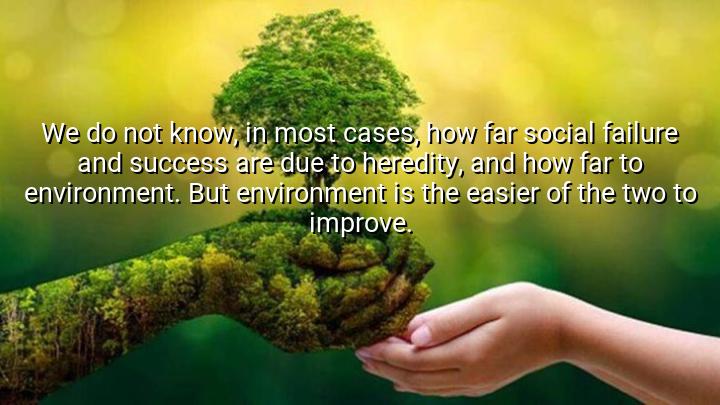




The quote by John B. S. Haldane, "We do not know, in most cases, how far social failure and success are due to heredity, and how far to environment. But environment is the easier of the two to improve," addresses the complex relationship between genetics and environment in shaping individual outcomes. Haldane suggests that both heredity (inherited traits) and environment (the conditions in which someone is raised) play significant roles in determining success or failure in life. However, he emphasizes that environment is more malleable and can be altered more easily compared to the genetic factors that individuals inherit.
The origin of this quote stems from Haldane’s background as a geneticist and biologist, where he studied the influences of both genetic inheritance and environmental factors on the development of individuals and populations. His work in the biological sciences led him to understand that while heredity plays an undeniable role in shaping traits like intelligence, health, and behavior, the environment—which includes education, social conditions, and opportunities—can have a significant impact on a person's life trajectory and can be influenced by societal change and policy.
Haldane’s statement also underscores the idea that while we may not fully understand the weight of heredity and environment in determining success or failure, improving the environment offers a more direct path to positive change. For instance, improving access to education, healthcare, and social services can enhance the opportunities available to individuals, potentially mitigating the disadvantages that might come from less favorable hereditary factors. By focusing on environmental changes, society can create a more equitable foundation for people to thrive, regardless of their genetic backgrounds.
In essence, this quote highlights the power of environment in shaping social outcomes and stresses that while we may have limited control over our genetic inheritance, we can take active steps to improve our surroundings and opportunities. Haldane’s words suggest that creating a supportive, nurturing environment is crucial for fostering success, and it is within our power to make those improvements, unlike the fixed nature of heredity.

AAdministratorAdministrator
Welcome, honored guests. Please leave a comment, we will respond soon