

We can no longer pretend that business is immune from the rising tide of environmental or social challenges or that companies can create value in isolation from the communities of which they are a part.
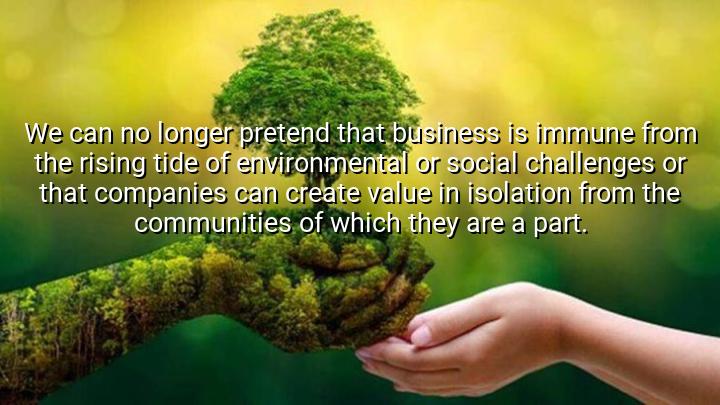




The quote by Paul Polman highlights the growing recognition that businesses cannot operate in isolation from societal and environmental challenges. By stating, "We can no longer pretend that business is immune from the rising tide of environmental or social challenges," Polman emphasizes that companies are increasingly affected by issues such as climate change, resource scarcity, and social inequality. Ignoring these factors can have long-term consequences for both the sustainability of the business and the well-being of the communities they serve.
The meaning of this quote centers on the concept of corporate responsibility. Polman asserts that companies must recognize their interdependence with the communities and ecosystems around them. True value creation goes beyond financial profits; it involves contributing positively to society and the environment, ensuring that business growth does not come at the expense of social or ecological health. This reflects a shift from short-term profit-driven models to a more sustainable and holistic approach to business strategy.
The origin of this quote can be traced to Paul Polman’s tenure as CEO of Unilever, where he became known for advocating sustainable capitalism and long-term corporate responsibility. Under his leadership, Unilever pursued policies that integrated environmental sustainability and social impact into core business operations. Polman often spoke about the necessity for companies to engage with their stakeholders, including local communities, governments, and non-profits, to create shared value.
Ultimately, this quote reflects a modern understanding that business and society are inseparably linked. Polman urges companies to move away from the idea of operating in isolation, instead embracing a role that balances profit, social equity, and environmental stewardship. It is a call for leaders to recognize that long-term success depends on the health and resilience of the broader world in which their businesses exist.

AAdministratorAdministrator
Welcome, honored guests. Please leave a comment, we will respond soon