

We are taught you must blame your father, your sisters, your brothers, the school, the teachers - but never blame yourself. It's never your fault. But it's always your fault, because if you wanted to change you're the one who has got to change.
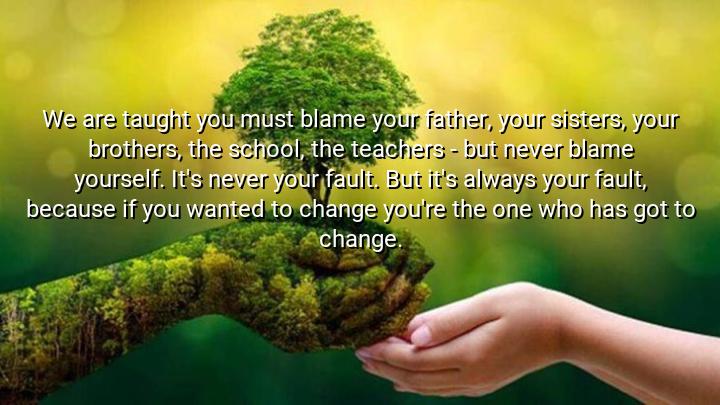




The quote “We are taught you must blame your father, your sisters, your brothers, the school, the teachers—but never blame yourself. It's never your fault. But it's always your fault, because if you wanted to change you're the one who has got to change” by Katharine Hepburn underscores the profound theme of personal responsibility. It critiques a cultural tendency to shift blame outward rather than inward, highlighting how society often encourages people to find fault in external circumstances rather than confronting their own choices and actions. Hepburn challenges this mindset by asserting that meaningful change begins with the individual.
Hepburn, a legendary actress known for her fierce independence and strong will, was never one to conform to societal expectations. This quote reflects her belief in self-determination and the power of taking ownership over one’s life. She implies that while it may be easier to blame others for our struggles, doing so only delays the possibility of growth. Real transformation demands the courage to look inward and accept that we hold the power—and responsibility—for our own development.
The contrast in the quote—“it's never your fault” versus “it's always your fault”—is a striking way to emphasize the shift from victimhood to empowerment. Hepburn isn't suggesting that external influences aren't real, but that clinging to blame immobilizes us. The only way forward is to recognize that if we desire change, we must take the first step ourselves. That inner shift is the foundation of both personal freedom and accountability.
Ultimately, Hepburn’s words are a call to embrace self-reflection and to reject the illusion that others control our destiny. By taking responsibility for our own transformation, we reclaim agency over our lives. Her message is both sobering and liberating: the path to change may be hard, but it is always within our reach—because it starts with us.

AAdministratorAdministrator
Welcome, honored guests. Please leave a comment, we will respond soon