

We are all afraid for our confidence, for the future, for the world. That is the nature of the human imagination. Yet every man, every civilization, has gone forward because of its engagement with what it has set itself to do.
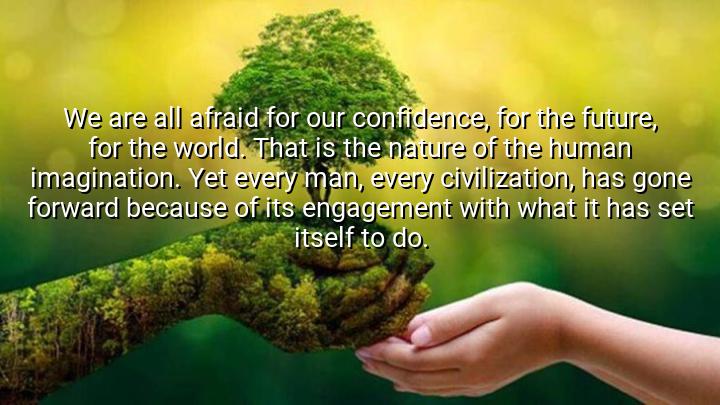




The quote, "We are all afraid for our confidence, for the future, for the world. That is the nature of the human imagination. Yet every man, every civilization, has gone forward because of its engagement with what it has set itself to do," comes from Jacob Bronowski, a British mathematician, historian of science, and philosopher. Bronowski is best known for his work on the nature of human creativity and the development of science. In this quote, he reflects on the role of fear and imagination in human progress, suggesting that while fear is a natural part of the human experience, it is our ability to confront and engage with challenges that propels us forward.
Bronowski acknowledges the fear that humans experience, particularly related to confidence, the future, and the state of the world. This fear is often tied to the uncertainties of life and the challenges of the unknown. However, he argues that imagination plays a key role in how we navigate these fears. While fear may seem paralyzing, it is actually the engagement with our fears and the imaginative processes that help us overcome them, pushing us to take action rather than retreat.
Despite the natural tendency to worry about the unknown, Bronowski points out that both individuals and entire civilizations have continued to move forward throughout history because of their drive to engage with what they have set out to accomplish. This sense of purpose and the willingness to engage with challenges, using imagination and creativity, are what enable progress. It's through this engagement with goals, even in the face of fear, that we manage to shape a better future.
Ultimately, the quote suggests that human imagination is not only a tool for dreaming but also for overcoming adversity. While fear is a natural response to uncertainty, it is the engagement with our imagination and ambitions that allows us to transform fear into progress, enabling us to achieve personal and collective growth.

AAdministratorAdministrator
Welcome, honored guests. Please leave a comment, we will respond soon