

We are a unique ape. We have language. Other animals have systems of communication that fall far short of that. They don't have the same ability to communicate complicated conditionals and what-ifs and talk about things that are not present.
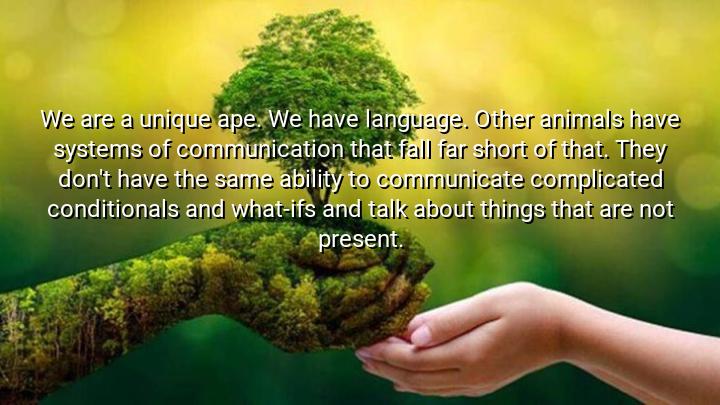




Richard Dawkins’ quote "We are a unique ape. We have language. Other animals have systems of communication that fall far short of that. They don't have the same ability to communicate complicated conditionals and what-ifs and talk about things that are not present" highlights the extraordinary capabilities of human language in comparison to other forms of animal communication. He emphasizes that while animals can communicate through signals or sounds, their methods are typically limited to immediate needs and simple responses. Human language, on the other hand, enables the expression of complex abstract ideas, including what-ifs and hypotheticals, which are essential for problem-solving, planning, and creativity.
Dawkins, a renowned evolutionary biologist, uses this distinction to point out that language is one of the key traits that sets humans apart from other species. While animals might communicate through gestures, sounds, or smells, their systems lack the depth and flexibility that human language offers. Humans can express and understand complicated concepts, such as future events, past occurrences, and imagined scenarios, which helps us navigate complex social structures and technological advancements.
The origin of this idea lies in the field of evolutionary biology. Dawkins’ work often explores how certain characteristics, like language, have evolved in humans to give us a distinct edge in survival and social interaction. The quote reflects his belief in the evolutionary uniqueness of human beings, particularly when it comes to cognitive abilities like language, which have played a critical role in our dominance over the planet.
Ultimately, Dawkins is suggesting that language is not just a tool for basic survival, but a cognitive leap that allows humans to connect, collaborate, and share complex thoughts in ways that are unmatched by other species. This ability to discuss things that are not immediately present—such as ideas, concepts, and theories—has shaped human culture, science, and society in ways that no other form of communication could.

AAdministratorAdministrator
Welcome, honored guests. Please leave a comment, we will respond soon