

Transient bodies are only subject to destruction through their substance and not through their form, nor can the essence of their form be destroyed; in this respect, they are permanent.
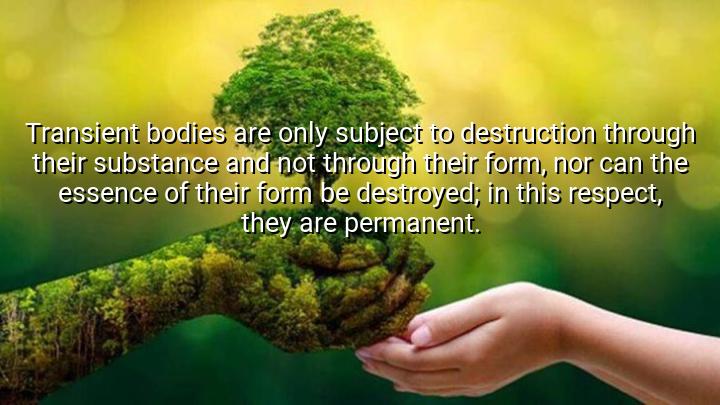




This quote by Maimonides reflects his deep engagement with philosophy, metaphysics, and theology. By describing transient bodies as subject to destruction only through their substance and not their form, Maimonides draws a distinction between the physical, perishable aspect of things and their enduring essence. In his view, while material objects may decay, the form—the underlying essence or organizing principle—remains permanent.
This idea is rooted in Aristotelian philosophy, which greatly influenced Maimonides. Aristotle distinguished between substance (the physical matter of a thing) and form (its essential nature). Maimonides adapts this framework to explain the durability of essence beyond material decay. For him, even when bodies are transient, the essence of their form endures, linking human existence and natural phenomena to a larger, enduring order.
The origin of this statement can be traced to Maimonides’ seminal work, “The Guide for the Perplexed,” where he sought to reconcile Jewish theology with Greek philosophy. Living in the 12th century, he aimed to provide intellectual and spiritual clarity for those struggling to harmonize faith with reason. His reflections on form, substance, and permanence were part of his broader effort to explore the relationship between the divine and the material world.
Ultimately, the quote underscores Maimonides’ belief in a layered reality where matter is impermanent, but essence has a more lasting truth. It serves as a reminder that while physical things may perish, the forms that define their existence remain part of a greater, enduring structure. This perspective bridges philosophy and spirituality, pointing to a universe that is both transient in body and eternal in essence.

AAdministratorAdministrator
Welcome, honored guests. Please leave a comment, we will respond soon