

Do not imagine that what we have said of the insufficiency of our understanding and of its limited extent is an assertion founded only on the Bible: for philosophers likewise assert the same, and perfectly understand it,- without having regard to any religion or opinion.
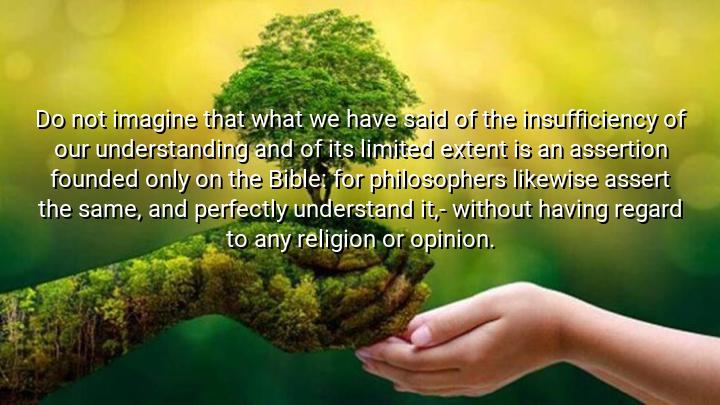




The quote by Maimonides emphasizes the limitations of human understanding and the recognition that our knowledge is often insufficient to grasp the full nature of reality. He clarifies that this acknowledgment is not solely derived from the Bible or religious teachings, but is also a perspective shared by philosophers, who arrive at similar conclusions through reason and reflection, independent of faith or doctrine.
Maimonides highlights the universality of intellectual humility. Both religious and philosophical traditions recognize that human cognition has limits, and that certainty about the ultimate truths of the universe is often beyond our grasp. This perspective encourages modesty, critical thinking, and continuous inquiry rather than dogmatic assertion or overconfidence in one’s knowledge.
The origin of the quote comes from Maimonides, a 12th-century Jewish philosopher, theologian, and scholar, known for integrating rational philosophy with religious thought. In works such as Guide for the Perplexed, Maimonides sought to reconcile faith and reason, demonstrating that insights about human understanding and the limits of knowledge are valuable across both religious and secular domains.
Ultimately, the quote conveys a message about humility, reason, and the pursuit of knowledge. Maimonides reminds us that recognizing the limits of our understanding is not a weakness but a sign of intellectual maturity, bridging the insights of both religion and philosophy to foster a deeper, more reflective approach to learning and belief.
I can also create a condensed, bolded version for quick reference if you want.

AAdministratorAdministrator
Welcome, honored guests. Please leave a comment, we will respond soon