

To me education is a leading out of what is already there in the pupil's soul. To Miss Mackay it is a putting in of something that is not there, and that is not what I call education. I call it intrusion.
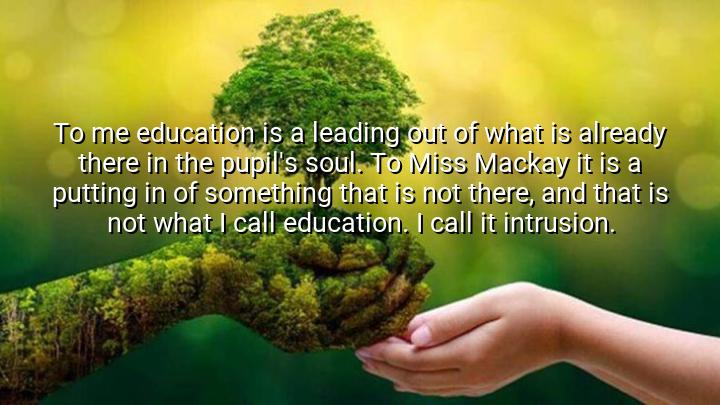




Muriel Spark's quote, “To me education is a leading out of what is already there in the pupil's soul. To Miss Mackay it is a putting in of something that is not there, and that is not what I call education. I call it intrusion,” contrasts two opposing views of education. Spark advocates for a more organic and student-centered approach, where the role of the educator is to draw out the inherent knowledge, talents, and potential within a student, rather than imposing external ideas or beliefs onto them. Education, in her view, should allow the pupil to discover and develop what is already present within them.
On the other hand, the character of Miss Mackay represents a more traditional, authoritarian approach to education, where the teacher's role is to impart knowledge and values that are external to the student’s own experiences or natural inclinations. Spark sees this method as an intrusion—a forceful imposition of ideas, rather than a nurturing of the student's inner capabilities. This perspective critiques the idea of education as a process of indoctrination, where the student is molded according to the teacher's agenda, rather than being allowed to grow based on their own intellectual and emotional development.
Spark’s view of education as a personal exploration also reflects a belief in the individual's autonomy and the importance of encouraging self-expression and critical thinking. By emphasizing the role of the student’s soul in the learning process, Spark acknowledges that education should be a dialogue between the learner and the world, not a one-sided transfer of information from teacher to pupil.
The origin of this quote comes from Spark’s unique perspective as both a writer and educator, known for her deep explorations of individuality and society. Her critique of traditional education reflects her broader concerns about conformity and the tension between personal freedom and social expectations. Through this quote, Spark advocates for a more liberating and transformative form of education—one that recognizes and nurtures the inherent potential within each student, rather than constraining it with external influences.

AAdministratorAdministrator
Welcome, honored guests. Please leave a comment, we will respond soon