

To live is to change, and to be perfect is to have changed often.
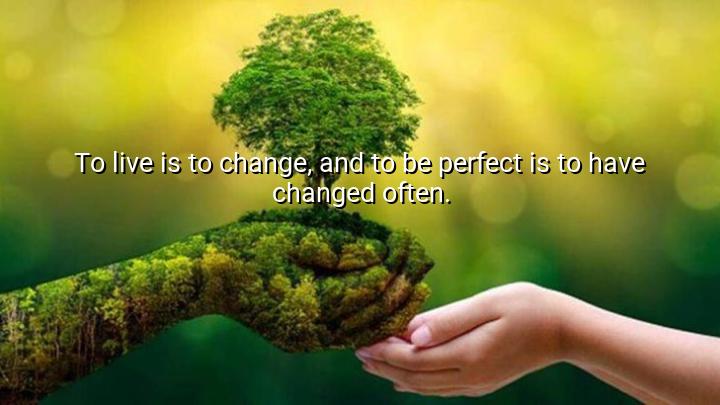




The quote "To live is to change, and to be perfect is to have changed often." by John Henry Newman emphasizes the essential role of change in the process of growth and self-improvement. Newman suggests that life itself is defined by change, and that those who strive for perfection or excellence must continually evolve. Rather than viewing change as a sign of weakness or instability, he presents it as a necessary condition of being truly alive and spiritually or intellectually mature.
The idea that perfection comes from frequent transformation challenges the notion that consistency or unyielding adherence to one belief or path is a virtue. Newman implies that wisdom and depth of character are built through reflection, adaptation, and the willingness to revise one's thoughts, beliefs, or behaviors in light of new insight. True perfection, in this sense, is not about being flawless, but about having the humility and courage to change repeatedly and meaningfully.
John Henry Newman, a 19th-century theologian, educator, and cardinal, initially an Anglican priest who later converted to Catholicism, was known for his deep engagement with faith, reason, and conscience. His personal journey—marked by significant religious transformation—gives this quote profound authenticity. Newman experienced firsthand the challenges and rewards of personal change, and his writings often encourage intellectual and spiritual openness.
Ultimately, Newman’s quote is a celebration of growth through change. It reminds us that to live fully is to remain flexible and receptive, constantly seeking deeper understanding. Far from being a sign of instability, frequent change is portrayed as the mark of a thoughtful and aspiring person, committed to learning and becoming the best version of themselves.

AAdministratorAdministrator
Welcome, honored guests. Please leave a comment, we will respond soon