

To focus on what makes us different, whether that's race, gender or religion, rather than what we have in common, has never served to bring people together.
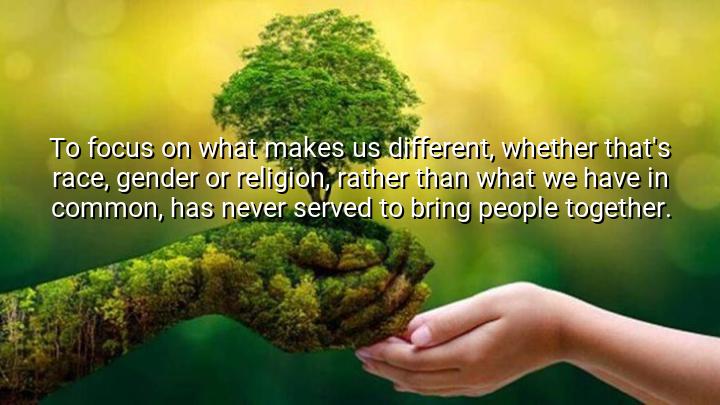




In the quote, "To focus on what makes us different, whether that's race, gender, or religion, rather than what we have in common, has never served to bring people together," Leslyn Lewis addresses the divisiveness that arises when people emphasize their differences instead of focusing on shared human experiences. She suggests that by highlighting things like race, gender, or religion, individuals and societies can unintentionally deepen division and separation rather than fostering unity and understanding. Lewis advocates for a more inclusive approach, where commonalities, rather than differences, are the foundation of connection.
Lewis's perspective calls attention to the harmful effects of emphasizing distinctions between people, often leading to conflict, stereotyping, and discrimination. By focusing on what unites us—such as shared values, goals, and experiences—there is a potential to bridge gaps and create more harmonious relationships across various social groups. She believes that common ground is a powerful tool for overcoming barriers and building stronger, more cohesive communities, where everyone feels respected and valued.
The quote also serves as a critique of social and political dynamics that often amplify divisions along identity lines, whether through rhetoric or policies that favor one group over another. Lewis argues that the ongoing focus on these differences may perpetuate polarization and hinder efforts toward equality and cooperation. The ultimate goal, according to her, should be to move past superficial distinctions and toward a more unified society that celebrates what makes us all human.
Leslyn Lewis, a Canadian politician and advocate, has spoken extensively on issues related to identity, diversity, and inclusivity. Her quote reflects a broader philosophy of promoting unity in a multicultural society, where embracing what people have in common, rather than highlighting their differences, can lead to a more peaceful and collaborative environment.

AAdministratorAdministrator
Welcome, honored guests. Please leave a comment, we will respond soon