

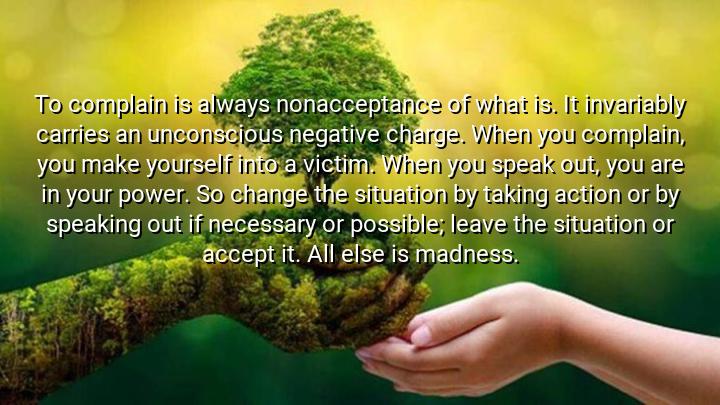
To complain is always nonacceptance of what is. It invariably carries an unconscious negative charge. When you complain, you make yourself into a victim. When you speak out, you are in your power. So change the situation by taking action or by speaking out if necessary or possible; leave the situation or accept it. All else is madness.
To complain is always nonacceptance of
To complain is always nonacceptance of what is. It invariably carries an unconscious negative charge. When you complain, you make yourself into a victim. When you speak out, you are in your power. So change the situation by taking action or by speaking out if necessary or possible; leave the situation or accept it. All else is madness.

To complain is always nonacceptance of
To complain is always nonacceptance of what is. It invariably carries an unconscious negative charge. When you complain, you make yourself into a victim. When you speak out, you are in your power. So change the situation by taking action or by speaking out if necessary or possible; leave the situation or accept it. All else is madness.
To complain is always nonacceptance of
To complain is always nonacceptance of what is. It invariably carries an unconscious negative charge. When you complain, you make yourself into a victim. When you speak out, you are in your power. So change the situation by taking action or by speaking out if necessary or possible; leave the situation or accept it. All else is madness.
To complain is always nonacceptance of
To complain is always nonacceptance of what is. It invariably carries an unconscious negative charge. When you complain, you make yourself into a victim. When you speak out, you are in your power. So change the situation by taking action or by speaking out if necessary or possible; leave the situation or accept it. All else is madness.
To complain is always nonacceptance of
To complain is always nonacceptance of what is. It invariably carries an unconscious negative charge. When you complain, you make yourself into a victim. When you speak out, you are in your power. So change the situation by taking action or by speaking out if necessary or possible; leave the situation or accept it. All else is madness.
To complain is always nonacceptance of

The quote "To complain is always nonacceptance of what is. It invariably carries an unconscious negative charge. When you complain, you make yourself into a victim. When you speak out, you are in your power. So change the situation by taking action or by speaking out if necessary or possible; leave the situation or accept it. All else is madness." by Eckhart Tolle presents a powerful teaching on mindfulness, personal responsibility, and emotional awareness. Tolle, a spiritual teacher and author of the bestselling book The Power of Now, is known for encouraging people to live fully in the present moment and to disengage from the egoic mind that thrives on resistance and dissatisfaction.

The quote begins with the idea that complaining is a form of nonacceptance—a rejection of reality as it is. Tolle argues that complaints don’t solve problems; instead, they feed an unconscious negativity, reinforcing a sense of powerlessness. When you complain, you assume the role of a victim, placing yourself at the mercy of external conditions rather than recognizing your ability to respond consciously.

However, Tolle makes a distinction between complaining and speaking out. Speaking out is an empowered action—it is rooted in clarity, not bitterness. When you take action or express your truth constructively, you reclaim your personal power. Tolle offers a practical framework: either change the situation, leave it, or accept it fully. Anything else, he says, leads to inner conflict and suffering—what he refers to as madness.

Ultimately, this quote encapsulates Tolle’s philosophy of radical presence and self-awareness. It challenges us to examine our emotional habits and to shift from passive reactivity to intentional living. By letting go of resistance and embracing either acceptance or action, we step into a state of inner peace and clarity—the very essence of Tolle’s teachings.

Eckhart Tolle
Eckhart Tolle

German - Speaker Born: February 16, 1948

Have 0 Comment To complain is always nonacceptance of

AAdministratorAdministrator

Welcome, honored guests. Please leave a comment, we will respond soon

Reply.
Information sender
Leave the question
Click here to rate
Information sender
0.25123 sec| 2561.883 kb