

To be immortal is commonplace; except for man, all creatures are immortal, for they are ignorant of death; what is divine, terrible, incomprehensible, is to know that one is immortal.
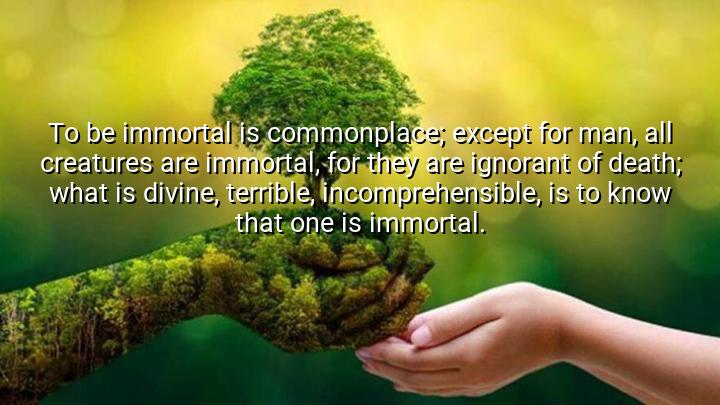




The quote "To be immortal is commonplace; except for man, all creatures are immortal, for they are ignorant of death; what is divine, terrible, incomprehensible, is to know that one is immortal" by Jorge Luis Borges reflects his deep philosophical musings on the nature of mortality and immortality. Borges is suggesting that while immortality is often considered extraordinary, in nature, it is a reality for every creature, except humankind. Animals, plants, and other beings do not have the conscious awareness of their mortality, making them, in a sense, "immortal" because they live in ignorance of death.
The statement also touches on the idea that for humans, knowing one's immortality would not be a gift but a burden. Borges contrasts the natural, unconscious immortality of other creatures with the human experience of being aware of one's inevitable end. He presents this awareness as something terrible and incomprehensible, as the knowledge of immortality would be far from freeing. It would mean living with the constant weight of existential anxiety, realizing that one’s existence never truly ends, which would fundamentally alter the human experience.
In Borges’s view, death and the awareness of it are what give meaning and value to life. If humans were truly immortal, it would negate the urgency and significance of their actions. The divinity of life, for Borges, lies in its finite nature, and the awareness of death adds a layer of depth to human experience that makes it both precious and poignant.
Borges’s meditation on immortality reflects his broader exploration of time, reality, and the limits of human knowledge. As a writer deeply fascinated with philosophical paradoxes, he often engaged with themes that question the nature of existence. In this quote, he uses immortality to provoke reflection on the human condition—what it means to live a finite life and how awareness of mortality shapes both personal identity and the larger fabric of human meaning.

AAdministratorAdministrator
Welcome, honored guests. Please leave a comment, we will respond soon