

The fact is that all writers create their precursors. Their work modifies our conception of the past, just as it is bound to modify the future.
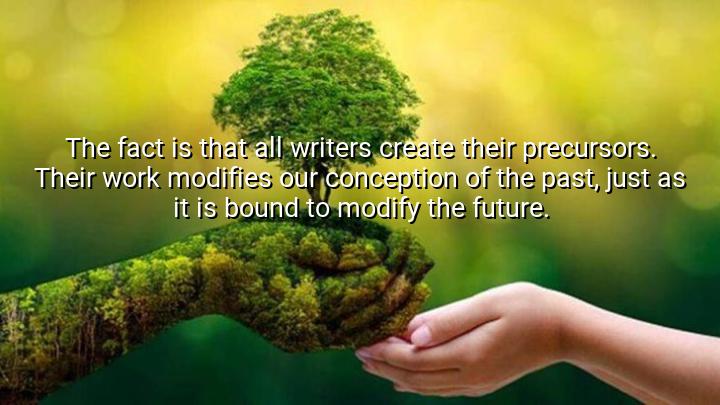




In this quote, Jorge Luis Borges, an Argentine writer and poet, reflects on the relationship between writers and the legacy they leave. He argues that all writers inherently create their precursors—that is, their work influences how we understand the works that came before them. By contributing new ideas, styles, or perspectives, writers reshape the way we view past literature, making it impossible to view earlier works without the lens of what has come after. In this sense, every new work modifies our conception of the past.
Borges suggests that writing is not just an individual act of creation but a part of a larger, interconnected web of literary influence. He implies that writers do not exist in isolation; their works are informed by and, in turn, shape the understanding of those who came before them. This creates a continuous cycle where literature constantly evolves, with each new work impacting the way we view both the present and the past.
The quote also touches on the idea that writing has a profound influence on the future. By adding to the collective pool of ideas and narratives, writers modify the future by shaping how future generations will think, write, and interpret the world. The creation of new literary works sets in motion a ripple effect that influences the development of culture, ideas, and society. Borges suggests that literature is both a mirror of the past and a window into the future.
Ultimately, Borges’ words highlight the cyclical nature of literary creation. Each writer contributes to a never-ending conversation with the past, present, and future, showing how literary works can transcend time and continue to influence generations. This reinforces the idea that writing is not a solitary endeavor but a dynamic, ongoing process of cultural exchange and evolution.

AAdministratorAdministrator
Welcome, honored guests. Please leave a comment, we will respond soon