

To be as good as our fathers we must be better, imitation is not discipleship.
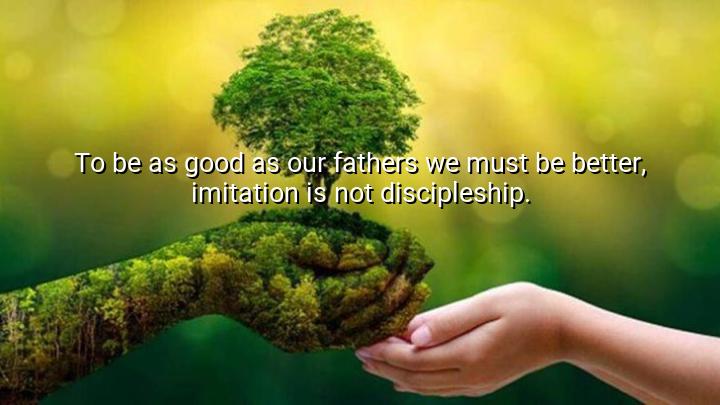




The quote "To be as good as our fathers we must be better, imitation is not discipleship" by Wendell Phillips emphasizes the idea that true respect and honor for those who came before us, especially our fathers, is not found in merely copying their actions, but in striving to surpass them. Phillips, a noted 19th-century abolitionist, orator, and advocate for social reform, was known for his progressive thinking and moral clarity. This statement reflects his belief in progress, growth, and the necessity of individual moral responsibility beyond passive admiration.
By asserting that "imitation is not discipleship," Phillips draws a distinction between blind repetition and meaningful legacy. To truly carry forward the work or spirit of a father or mentor, one must not only uphold their values but also expand upon them, adapting to new challenges and striving for higher ideals. In the context of social justice, where Phillips spent much of his life, this meant pushing boundaries and not settling for the status quo, even if it was set by revered predecessors.
The quote likely emerged from Phillips’s numerous speeches where he encouraged his audience to think critically and act courageously. It served as a call to the younger generation to move beyond reverence and take bold action, using the foundation laid by earlier generations as a launching point, not a finish line. For Phillips, discipleship meant dynamic engagement, not passive obedience.
In essence, this quote is a powerful reminder that honoring the past requires a commitment to the future. It challenges individuals to embody the principles of their fathers while also evolving, improving, and leading with their own voice. Wendell Phillips’s words continue to resonate as a call to critical thinking, moral courage, and authentic leadership.

AAdministratorAdministrator
Welcome, honored guests. Please leave a comment, we will respond soon