

Time heals griefs and quarrels, for we change and are no longer the same persons. Neither the offender nor the offended are any more themselves.
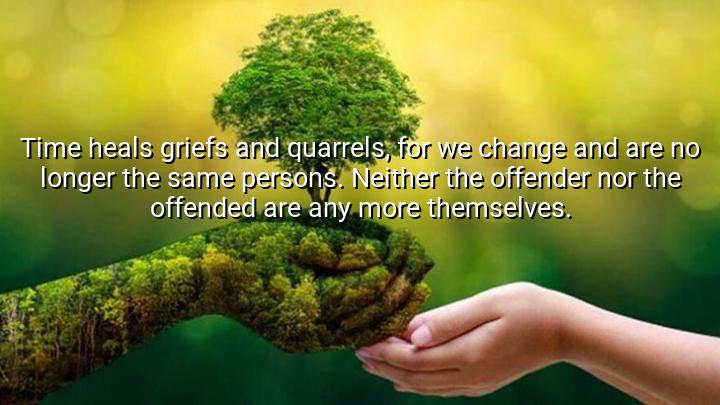




This profound quote by Blaise Pascal explores the transformative power of time in the context of grief and conflict. When he says, “Time heals griefs and quarrels,” Pascal acknowledges a universal truth—that emotional wounds often fade as time passes. But he goes deeper, suggesting that healing occurs not only because of the passage of time itself, but because we change. The people who once suffered or fought are no longer exactly who they were at the time of the pain or disagreement.
Pascal emphasizes that neither the offender nor the offended remain the same, implying that personal growth, reflection, and the natural progression of life lead us to evolve emotionally and psychologically. As a result, the original sources of pain or conflict may lose their power, becoming less relevant to who we have become. This change in identity—in both perception and character—is central to his idea of how reconciliation and healing occur over time.
The origin of this quote comes from Pascal’s work Pensées, a collection of thoughts and reflections on the human condition, faith, and philosophy. As a brilliant mathematician, physicist, and religious thinker, Pascal was deeply interested in both rational analysis and the emotional complexities of human nature. His insights often blend spiritual understanding with psychological observation, as seen in this quote.
Ultimately, Pascal’s message is one of quiet hope and humility. He reminds us that change is inevitable, and through that change, we gain the ability to move past hurt and conflict. Time, in his view, does not simply dull pain—it transforms us, making forgiveness and peace not only possible but natural as we grow into new versions of ourselves.

AAdministratorAdministrator
Welcome, honored guests. Please leave a comment, we will respond soon