

This is an anxiety driven world - the whole world is driven by anxiety. It is anxiety about the aftermath of the global financial crisis; it's anxiety about inequality and about computers replacing jobs.
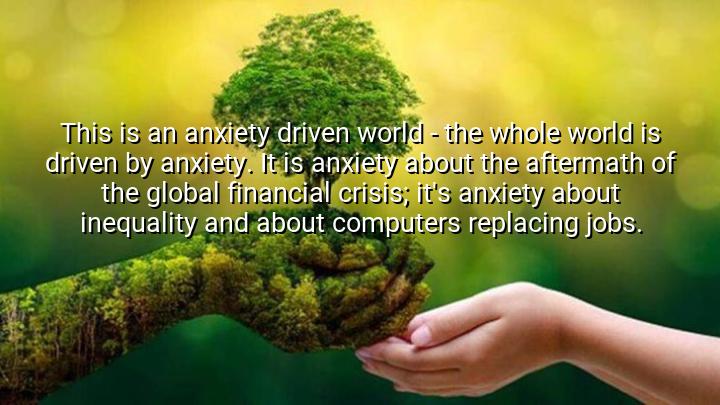




Robert J. Shiller’s quote highlights the pervasive nature of anxiety in modern society, suggesting that much of the world’s current challenges are fueled by widespread fear and uncertainty. He identifies several sources of this anxiety, including the aftermath of the global financial crisis, growing inequality, and the fear that computers and automation will lead to the loss of jobs. Shiller’s statement reflects the broader societal concerns about economic stability, social justice, and the future of work, all of which contribute to a sense of collective unease.
The origin of this quote stems from Shiller's work as a Nobel laureate in economics, known for his research on financial markets and behavioral economics. As someone deeply involved in understanding the causes of market volatility and economic insecurity, Shiller has often addressed the psychological and societal factors that influence economic behavior. His observation about the current state of global anxiety is grounded in his expertise on how people’s emotions and fears shape economic decision-making and public policy.
Shiller’s quote also touches on the broader societal implications of technological change. The rise of automation and the increasing role of computers in the workforce has sparked fears of job displacement, particularly for low-skilled workers. This contributes to a growing sense of economic insecurity as many worry about the future of their livelihoods in an increasingly automated world. Shiller’s statement underscores how these concerns amplify the anxiety surrounding the global economy and contribute to social and political instability.
Ultimately, Shiller’s quote serves as a critique of the current state of global society, where economic fears and technological changes are leading to a culture of anxiety. It calls attention to the need for a more balanced approach to economic policy and the integration of technology into the workforce in a way that addresses these anxieties and creates a more stable and equitable society.

AAdministratorAdministrator
Welcome, honored guests. Please leave a comment, we will respond soon