

There's only one effectively redemptive sacrifice, the sacrifice of self-will to make room for the knowledge of God.
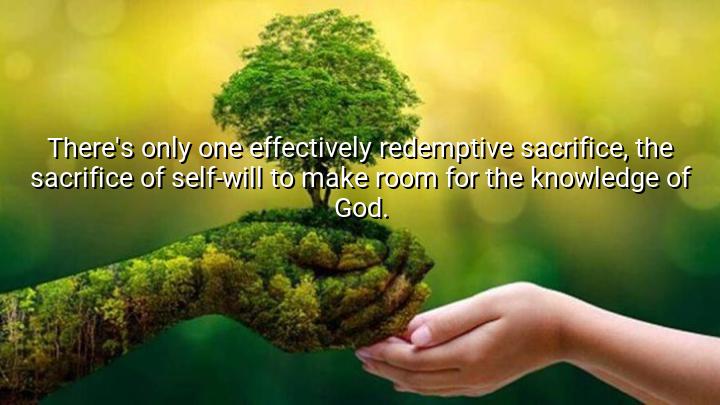




The quote "There's only one effectively redemptive sacrifice, the sacrifice of self-will to make room for the knowledge of God" by Aldous Huxley speaks to the transformative power of surrendering one’s own desires and ego in order to embrace a deeper spiritual understanding. Huxley is suggesting that true redemption, or spiritual salvation, comes not through external actions or rituals but through the inner act of yielding one’s self-will—the personal desires, pride, and ego—to make space for a more profound connection with God. This implies that spiritual growth begins with humility and the abandonment of one's own will in favor of divine wisdom.
Huxley’s view reflects his philosophical and spiritual beliefs, which blended elements of mysticism, humanism, and Eastern philosophy. In many of his works, particularly in The Perennial Philosophy, he explored the idea that human beings must transcend their individual egos and open themselves to a greater, universal knowledge of the divine. The sacrifice of self-will represents the letting go of personal ambitions or desires that often cloud one’s perception of the divine and the deeper truths of life.
The origin of this quote lies in Huxley’s exploration of spirituality and the human search for meaning, particularly within the context of his studies on mysticism and human consciousness. Huxley believed that the true path to spiritual enlightenment and understanding of God required a selfless attitude, where the individual puts aside their personal will to be more attuned to higher, universal truths. This is often associated with the practices of meditation, self-reflection, and mindfulness found in various religious and spiritual traditions.
Ultimately, this quote underscores Huxley’s belief that spiritual redemption and true knowledge of God are achieved not by external actions, but through an inner transformation that requires self-sacrifice. It is only by stepping aside from our personal desires and ego-driven motives that we can make space for a deeper understanding of the divine and experience spiritual growth.

AAdministratorAdministrator
Welcome, honored guests. Please leave a comment, we will respond soon